 |
BRYANT G BAYLIFFE |
|
| Section 1
Six Clerks Office, London, Esq. (1664 - 1733)
|
||
|
|
|||
| Section | 1 | Title and contents | |
| ditto | 2 | Charles Bayliffe - The Story | |
| ditto | 3 | Arms of Bayliffe impaling Norborne | |
| ditto | 4 | Map of Holborn, London, Middx. 1676 | |
| ditto | 5 | The River Fleet, Holborn, Middx. circa 1700 | |
| ditto | 6 | Barnard's Inn, Holborn, London, Middx. | |
| ditto | 7 | Marlborough Grammar School, Wilts. 1578 - 1790 | |
| ditto | 8 | Monkton Manor Court Baron - 1734. Admittance of Mary Bayliffe | |
| ditto | 9 | The Six Clerks Office, Chancery Lane, London, Middx. 1622-1782 | |
| ditto | 10 | Genealogy of Norborne of Calne and Bremhill, Wilts. | |
| ditto | 11 | ditto Rogers of Bromham, Wilts. | |
| ditto | 12 | ditto Estcourt of Swinley and Kingston St. Michael, Wilts. | |
| ditto | 13 | ditto Higges of Coventry, Warks. and Colesbourne, Glos. | |
| ditto | 14 | ditto Hoy of London and Jamaica | |
| ditto | 15 | Arms of Higges of Coventry, Warks. and Colesbourne, Glos. | |
| ditto | 16 | Notes and Sources | |
| Section 2 | ||
|
The Six Clerks Office, London, Middx. (1664 - 1733) ****** CHARLES BAYLIFFE was the youngest of 4 sons born to William Bayliffe of Monkton juxta Chippenham, Wilts., Gent. and his second wife Elizabeth, the only daughter of John Norborne of Upper Studley, Calne, Wilts. Gent. Additional details of this family are shown in the genealogical tables at the end of this piece. Charles was baptized at Chippenham 6 June 1664 when his father was 63 years old, and his mother not yet 40 years of age. By the time he was 21 years of age he had a good education as befits a fourth son who would have to look outside the family estate for his livelihood. When Charles reached his majority in 1685 he received £200 under the terms of his father's Will. Charles was aged 9 years when his father died in 1673 and his older brother William, who held that part of the Monkton estate from which the legacies were to be paid, died in 1685. His brother William's widow Elizabeth (Flower) who became Administrator of William's estate arranged the payment. Henry his only remaining brother was well established in the other family leaseholds in Chippenham and Hardens. Charles did however enjoy some income from the 10 acre copyhold of Oathills1 for his life, though the management of it was left to his brother Henry. Meanwhile Charles went up to London to seek his fortune. The Admission Records of Barnard's Inn, Holborn, Middx., show that Charles Bayliffe was of Chancery Lane, Middx. when he was admitted to the Inn 18 November 16862, generally, for a fine of 6s 8d. Barnard's Inn, an Inn of Chancery offered cheap lodgings and further classical and legal training with the object of members rising to the associated Inn of Court. For Charles this would have been Gray's Inn if he wished to be called to the Bar. By the last decades of the 17th century the Inns of Court had become more exclusive, and the Inns of Chancery were being relegated to producing the 'underclass' of the profession to be called variously, lawyers, attorneys, solicitors, or even gentleman practisers. A parallel development where attorneys were trained by apprenticeship or indenture in lawyers chambers up and down the country, only hastened the demise of these junior Inns which eventually became little more than lodgings for the sons of the middling orders whilst they sampled the pleasures of city life. The association of Charles Bayliffe with a dwelling in Chancery Lane is confirmed in a deed3 since lost, involving Susan Bourchier of Chancery Lane, Middx., spinster, and Margaret Bourchier dated 1686, concerning the Bayliffe family of Monkton, Chippenham and connected with Walter Grubbe Esq., of Potterne, Wilts4. The document included the Bayliffe seal 'a chevron between three hearts, with a difference'. This differencing undoubtedly refers to Charles since he was not yet head of the family. These two spinster sisters were daughters of Walter Bourchier of Barnsley, Glos., Esq., J.P., who died 11 May 1648 aged 63. Their brother Anthony, a Linen Draper of Holborn, had died in 1674 and another sister Thomasine had married Thomas Grubb of Potterne, Wilts. The Bayliffe and Bourchier families were related through Catherine, a daughter of Thomas Bourchier of Barnsley, who married Charles Pleydell, later Sir Charles of Midgehall, Lydiard Tregoze, Wilts. the grandson of Gabriel Pleydell mentioned in a separate account. The Bourchier, Grubb, Pleydell, and Bayliffe families all had connections with Lincoln's Inn, Chancery Lane, and the Middle Temple. In his novel 'Great Expectations' Charles Dickens describes the scene some 150 years after Charles joined the Inn. Having walked from Bartholemew Close east of the Fleet River, our hero Pip walked westwards up Holborn Hill and past St. Andrew's Church, when: 'we were at Barnard's Inn ... I had supposed that establishment to be an hotel kept by a Mr Barnard...whereas I now found Barnard to be a disembodied spirit or a fiction, and his Inn the dingiest collection of shabby buildings ever squeezed together in a rank corner as a club for Tom-cats'. We must remember that the premises did not have the good fortune to be destroyed in the Great Fire of London in 1666, and were thus denied the necessity of rebuilding. The church of St. Andrew in Holborn enjoyed a prominent position almost at the top of Holborn Hill and was as fashionable in its time as St Martins in the Fields. In the days of the first Elizabeth Chancery Courts had been held in its chancel and would be crowded with professors of the law from the legal Inns nearby, suitably gowned, coiffed and bewigged, their swords buckled to their sides. The church barely survived the Great Fire in 1666 and was remodelled in a mixed style from Wren's design in 1686, the very year that Charles was admitted to Barnard's Inn a few yards further along Holborn. With the construction of Holborn Viaduct in the 19th century, the church was relegated to an obscure situation many feet below the new roadway level, and the surrounding streets and buildings destroyed. As William Hone put it in 1838: 'Ah! what a goodly sight was Holborn Hill in my time. Then there was a comely row of fruit stalls skirting the edge of the pavement from opposite the steps of the church to the corner of Shoe Lane. The fruit stood on tables covered with white cloths ... pears and apples were neatly piled up in ha'p'orths for then there were no pennyworths'. His association with the Inn was continuous, with the Barnard's Inn archives showing that his Tax Assessment in 1694 was £100 at 4s / £; an Antient in 1709 and a retiring Antient in 1731. It is unlikely that he had lodgings in the premises for long, since he married Mary Higges in 1695 when he was 30 years of age. By the mid 1720s we find Charles living in Warwick Court5, Holborn (leading to Gray's Inn Place), which was almost directly opposite the junction of Chancery Lane with High Holborn. Charles was to make a career in the Six Clerks Office in Chancery. Precisely when he started is not known, but reference to his having this post is to be found in the succeeding note to his obituary in the Gentleman's Magazine6 viz: 'Mr Bailiff, one of the Sixty Clerks in Chancery, reputed worth £10,000'. The Office enrolled commissions, pardons, patents, warrants, etc, that had passed the Great Seal and dealt with the increasing work load of the Court of Chancery. The Six Clerks Office consisted of the Sixty Clerks (ten for each of the Six Clerks) and some under-clerks who also acted as agents and attorneys to clients and suitors in Causes which were litigated in Chancery. Charles became one of these Sworn Clerks or Clerks in Court as they were sometimes called, who were from the same background as solicitors and attorneys, being prosperous members of the middling orders. The Six Clerks Office7 was to be found on the west side of Chancery Lane south of Carey Street, just outside the boundary of the City and opposite the Rolls. The site is now covered by the Law Society, formerly known as the Law Institute. The building in which Charles Bayliffe practised, from about 1693 to 1731, was built in brick on the site of an original which had burnt down in 1621. The building extended from Bell Yard to Chancery Lane. 'The Rolls', now the site of the Public Record Office lay opposite on the east side of Chancery Lane. To the north side and rear fronting Weedon Street were buildings demolished in 1865 to widen the roadway, which was incorporated into Carey Street and it's junction with Chancery Lane. The south elevation overlooked a narrow passage to other buildings forming part of their site which contained the kitchens, cellar entrance etc. The entrance to the passage from Chancery Lane was under an narrow arch and within a few yards on the right was the door leading to the Inrolment Office. Towards the west end of the building was the principal doorway to the Hall. The first floor consisted of one long room containing four rows of seats where the Clerks, together with their under-clerks transacted the Office business. According to Cavendish Weedon in 1720: 'they write by candle light in the daytime annoyed with the smoke and smell of candle grease and are so many and so near crowded up together in little boxes'. A report by the Office in 1731 reads 'While the Causes are in agitation the Records remain in their respective studies ... or in the seats of their sworn clerks, but when determined, were carried up to the Record rooms over the Office ... several of the pillars are giving way ... some of the floors of the Record rooms sinking very much, and the north wall is beginning to part from the roof' It was 50 years before better conditions would be available with the move to more substantial accommodation at Stone Buildings, Lincoln's Inn in 1778. The old building was converted into barracks during the Gordon Riots (1780) for the Northumberland Militia, who were doing duty in nearby Lincoln's Inn. The property was finally sold by Order of the Court of Chancery in 1781 for £1,155. It is clear that whilst Charles Bayliffe was usually titled as of Barnard's Inn he derived his income from his lucrative position as one of the Sixty Clerks. The position was no doubt secured through the influence of his father and grandfather (both members of the adjacent Lincoln's Inn) and Sir Thomas Estcourt one of the Masters of the Six Clerks. Charles' eldest sister Elizabeth had married the son of the Rev. George Estcourt of Swinley, Kington St Michael, Wilts., a younger brother of Sir Thomas Estcourt who lived at 21 Bell Yard next to the Six Clerks, when staying in London. Charles would have regularly travelled between Wiltshire and London on the Bristol and Bath Road, and would probably have been suitably horrified at the sight of the gibbets at Tyburn then in regular use as he approached Holborn from the west. His destination was within sight of the famous Middle Row (demolished 1867) in Holborn, and he would have wondered at the contrast between the silence and easy pace of his rural upbringing in north Wiltshire, and the bustle and excitement of the capital city. The Searle family of Dogmersfield, Hants. became close friends of the Bayliffes in Holborn through a son George, who until 1693 was servant and accountant to the famous Major John Wildman living at Little Queen Street, St. Giles in the Fields, only a few yards from Lincoln's Inn Fields. After his marriage in 1692 George Searle was settled at Brooke Street, Holborn, opposite Barnard's Inn. The children of George Searle and Susannah Middleton were baptized at St. Andrew's, Holborn, in the first decade of the 18th century as were those of Charles Bayliffe and Mary Higges. Susannah was cousin to Mary Higges, being the daughter of John Middleton and Susannah Higges, the sister of Richard Higges, Mary's father. Charles married Mary 14 October 1695, the youngest daughter of Richard Higges of Coventry, Warks. MD, a Doctor of Physic and 4th son of Thomas Higges of Colesbourne, Glos. and Sarah the daughter of Samuel Snell, Draper, Alderman and Mayor of the City of Coventry (1649). It was William the father of the above Thomas Higges who bought the Manor of Colesbourne from Sir Edward Harewell, Knt, in 1602. William Higges also had a residence in Stepney, then a rural suburb of London. The Colesbourne estate passed to Thomas on the death of William in 1612. Thomas bought additional lands at Withington, Glos. in 1624 and he died in 1649 leaving the estates to his son Thomas the elder brother of Dr Richard Higges. In 1672 Thomas conveyed Colesbourne and Withington to Samuel Sheppard. The families of Bayliffe and Higges had been acquainted most of the 17th century through the Inns of Court, and residence in and around Holborn, Middx. As early as 28 May 1622 the 21 year old trainee William Bayliffe of Lincoln's Inn the father of Charles, signed as co-defendant with others including Thomas and John Higges, a Bill in Chancery regarding the Rectory and Parsonage of Cheltenham, Glos. concerning apportionment thereof for Robert Higges of Cheltenham, Gent.8 In 1675 Dr Richard Higges held land in St Michael's Parish on the boundary with Stoke Parish in Coventry, and supplied goods to the City Pesthouses9. A document10 survives thus: '24 June 1676 between Gilbert Adderley, clothier of City of Coventry, Thomas Adderley his son of Little Lawford, Clerk, and Richard Higges of the City of Coventry, Doctor of Phisicke; a messuage in Little Park Street previously purchased by Gilbert Adderley of Thomas Chanty, Citizen and Ironmonger of London'. Mary's father died and was buried at St Michael's Church 3 November 1690, followed shortly afterwards by her mother. No doubt this prompted Mary's London relations to give her a home, and it perhaps explains why it was necessary for Charles to obtain a Marriage Licence which read: 'Bayliffe, Charles of St. Andrew's, Holborn. Gent. bachelor, 30. and Mary Higges of St. Clement Danes, Middx. Spinster about 21, her parents dead, at St. Giles in the Fields, Middx. on...14 Oct 1695 F.'11. It is through Mary Higges that kinship with William Shakespeare can be shown12. Mary, who was baptized at St. Michael's, Coventry, War, 30 May 1674, had 6 children between 1699 and 1712 who were all baptized at St. Andrew's, Holborn. As the children grew up the boys appear to have spent more time at the family home at Seagry, though all the evidence suggests that Charles and Mary favoured living in London. The children were given a good education and the boys in particular as we shall see later had a classical education at Marlborough Grammar School in the period 1715 to 1725, with their home base at Seagry. It is clear that Charles was investing part of his income in land north of Chippenham in conjunction with his brother Henry. Among other acquisitions, the main purchase is detailed in an Indenture13 dated 13 January 1702, between 'John Stratton of Over [Upper] Seagry, Gent, his wife Mary, Thomas Stratton of the same, Gent. son of him the said John, and John Webb of the same place, Yeoman, the only surviving son of the Mary which she had by John Webb, deceased, her former husband, on the one part; and Charles Bayliffe of Barnard's Inn, London, Gent, of the other part'. For the sum of £660, the land included 12 acres of pastures called Down Leyes, with dwelling house, outhouses, barns, stables, orchards, gardens, courts, yards, and backsides. Also a tenement occupied by John Gale, 18 acres of pasture called Stoneing Bridge, and 3½ acres of meadow near the River Avon called Hungerford Mead. Charles must then have refurbished the house to be known as the Manor House and later as Manor Farm. In addition to freeholds and leaseholds at Tytherton Kellaways in Bremhill Parish, he also leased land in Seagry from the Earl Radnor's Estate paying £18 yearly rent14. The only other surviving brother of Charles was Henry who died in 1722. His second wife Judith and Elizabeth a daughter by the Henry's first marriage both died in 1727 leaving all their estate to Charles. At a Court Baron15 of the Manor of Monkton juxta Chippenham held in 1728, Charles was now readmitted to the tenancy of the copyhold field of Oathills. By the early 1730s Charles was paying a Seagry poor rate made for 15 the yardland16 'Rimall's 6s; Sparrows 5s; p't of quarter 3s; Stratton's 15s; Ye farme £2 1s 5d; Hilliars 2s 6d; Adeys 11s 6d; Mary Adeys 15s 6d; Skues & Adeys 1s 4d; Total £5 1s 3d'. The total Poor Rate for the parish of Seagry for 1733 was £23 9s 0d, making the Bayliffe contribution between one quarter and one fifth of the total. Although Charles had latterly always been referred to as being of Seagry, he died at Chippenham and was buried at St. Andrew's Church with his ancestors 17 May 1733. He had made his Will 25 October 173217, and with two adult sons he was able conveniently to settle the Seagry property on his eldest son Charles junior, and the Kellaways properties on Richard. Mary his wife was to have the profits of his copyholds around Chippenham, and an annuity of £80 out of his freehold land and estate 'in lieu of all Dower and Thirds at Common Law'. His four daughters received £800 apiece which gives some idea of his relative affluence. Witnesses to the Will were John Merewether, Thomas Harris, and William Goldney, which was Proved 10 July 1733 at London. Upon the death of her husband Charles in 1733, Mary took up the copyholds under the Will. The Manor Roll for Monkton juxta Chippenham records a Court Baron18 attended by her attorney held in 1734, where Mary is given a 'special admittancy' to Oathills and shortly thereafter the copyhold was occupied by a Mr George Lodge. Mary was clearly not a country girl and as soon as was decent confined herself to her home in London. Mary made her Will 2 February 173819 then living at Red Lyon Street, London giving the income from her Wiltshire copyholds to her daughter Susanna, who was also made sole executrix. Susanna was of course unmarried and unlike her other unmarried sister Mary of Seagry, she lived in Drury Lane not far from her mother's home. The widow Mary was buried at St. Andrew's, Holborn, 26 February 1738 described in the register as being of the parish of St George. This is the new parish of St George the Martyr which was formed out of the western part of the increasingly populous parish of St. Andrew's, Holborn in 1723. Rather confusingly St George, Bloomsbury was formed out of eastern part of the adjacent parish of St Giles in the Fields in 1731. Sarah the eldest daughter was baptized 27 April 1699 at St. Andrew's, Holborn, Middx. and received an £800 legacy in her father's Will. Following the death of her father in 1733 and still a spinster, Sarah and John Lancaster a Distiller and widower both of St. Giles in the Field, Middx. married by Licence 25 February 1735 at St. Sepulchre, London. John apparently traded from Budge Row, Walbrook in the City.20. Sarah & John made a Bill of Complaint dated 8 May 1735 against the executors of her father's Will for non-payment of her legacy. Sarah died within weeks and was buried at St James, Piccadilly, Westminster, Middx. John now a widower resubmitted the Bill 1 September 1735. As Sarah's administrator John received the final half of Sarah's legacy with interest added, 11 December 1735 from the surviving executor Richard Bayliffe21. Mary Bayliffe the second daughter was baptized 4 November 1700 at St. Andrew's, Holborn, Middx, and was guaranteed her independence by her father's legacy of £800. She appears to be the only daughter to have been based at the Manor House, Seagry, though there is evidence that on occasions she stayed with friends and relations in Chippenham and London. Mary recorded monies received and disbursed on her late brother Richard's estate from 1737 to 1741. After the death of her brother Richard in 1737 Mary had to pay 1s 6d for a messenger and expenses to 'Wadden' [Whaddon near Melksham] to treat with a tenant for taking the farm at Seagry. Much effort has gone into the search to identify Richard's property at Tytherton Kellaways and from the few options available a reasonable assumption would be the leasehold Kellaways Farm and the Manor House (owned by the Long family of Whaddon). In the London Evening Post dated Saturday 11 August 1739 a classified advertisement offers the freehold estate owned by Richard in the same village including a large farmhouse, orchards etc. The timber was valued at £1000. Mary accepted the rent for her late brother's farm at Kellaways from Abraham Tucker at £150 p.a. and lesser sums no doubt for cottages from George Fricker and Giles Hodges. In conjunction with her joint executor Michael Spateman of London she made various payments against her late brother's estate which at his death included all the family properties at Seagry and elsewhere. One interesting charge was 1s 0d for interment and woollens - the clergy were obliged by law not to accept shrouds made from material other than wool. On 14 January 1738 she paid Ann Ashton 1s 6d for sitting up 3 nights with her brother during his illness. On 21 October 1739 William Carey received £2. 3s. 8d. for making Richard's coffin, and later still his physician Mr Sadler was paid £1 1s. for attending Richard. The sale of Richard's interests in Kellaways and elsewhere was completed by the end of 1742 when Mary paid herself £27 6s 9d as arrears of interest from the Estates of her father Charles and her brother Richard. In 1748 she paid £30 to be apprenticed22 as a mantua maker to Rebecca Mann of St Ann's, Westminster. It is unlikely that her resources were getting low, but perhaps in her circle it was a social asset to be skilled at the making and repair of silk dresses, gowns, petticoats and the like for the middling and upper orders. It would certainly have occupied those long silent winter days and nights in rural Wiltshire. When the unmarried Mary made her Will 25 April 175923, the family disputes over the inheritance involving her two brothers Charles and Richard, sister-in-law Elizabeth Russell (formerly Bayliffe nee Searle) and nephews Charles and George Searle Bayliffe, had finally been resolved. Thomas Vines one of the witnesses to her Will, a recent arrival in the village from Great Somerford, was living on the north west corner of the junction of Five Thorns Lane and the Somerford Road. A Codicil dated 25 May 1760 concerning minor bequests was added to the Will just before her death. Her close friends in the vicinity to whom she left money to buy mourning rings included, John Smith of Great Somerford, Gent., and his wife Elizabeth, Mrs Rebecca Browne and Mrs Elizabeth Sloper. Mary must have had a special association with her brother-in-law Clement Hoy of Chelsea, Middx., Esq. to whom she left £150. He was now the widower of her younger sister Ann, who had died a few years earlier. To judge by the Wills of her mother and sister Susanna, there must have been some estrangement between the sisters. Mary died unmarried 3 June 1760 at 60 years of age, and was buried at Seagry on the 5th. There is a monumental inscription to her memory in the nave of St. Mary's Church. Her Will was Proved 9 August 1760 with Administration granted to her nephew and sole executor George Searle Bayliffe who was then 26 years old. Susanna the third daughter was baptized 27 July 1702 at St. Andrew's, Holborn, Middx. She was undoubtedly her mother's favourite and almost certainly helped her mother in the period up to her mother's death in 1738. She never married and apparently preferred city life to judge from her properties. In 1748 her principal address was Strutton Grounds in the parish of St John the Evangelist, Westminster, Middx. She also held leasehold properties next to the church at Isleworth, Middx. and at Benet Court, Drury lane, in the Liberty of Westminster. Friends who lived with her and benefited under her Will made 4 July 1748 were, Mrs Mary Furnell the executrix and Mrs Dorothy Nightingale, both spinsters. Significantly, there is no mention of her surviving blood relations. Her Will24 was Proved 9 Jan 1756 at London, on the oath of Mary Furnell, spinster. Charles Bayliffe the eldest of two sons was baptized 11 November 1705 at St. Andrew's, Holborn, Middx., with his early childhood in the atmosphere of the legal quarter in Holborn and to a lesser extent the financial centre of the City of London. Within a few hundred yards of each other in Holborn were Gray's Inn, Furnival Inn, Thavies Inn, Barnard's Inn and Staple Inn. On the south side of High Holborn, you find Lincoln's Inn and the Six Clerks Office on the southern corner of Chancery Lane and Carey Street. Nearing Fleet Street another group of legal properties appear, including Clifford's Inn and Serjeant's Inn. The Temple with the nearby junior Inns of Clements Inn, New Inn, and Lyons Inn was just across Fleet Street towards the river. It would be a mistake to take too romantic a view of early 18th century London, given the sights which in the 20th century would be offensive but were then an every day occurrence. The impaled heads adorning Temple Bar, where you could pay a halfpenny to look at them through a spy-glass. Or join the crowds of people who would turn out to view the grisly processions from Newgate Gaol westward over the Fleet Bridge, up Holborn Hill, through High Holborn and the Tyburn Road (now Oxford Street), to the execution at the Tyburn gibbet (now the site of Marble Arch). In the slum districts around the Church of St Giles in the Fields, one quarter of the houses were gin-shops and with an unconcerned gentry and clergy it is hardly surprising that John Wesley found fertile ground in the working classes trying to escape the despair in their lives. Charles' father was the product of at least three generations of barristers, but there were already signs that the later generations were not going to achieve quite such high ideals. With the increasingly seedy nature of the junior Inns, and the greater academic isolation of the Inns of Court, there was now a boost to the number of grammar schools devoted to classical education in preparation for Law, whether at Inns of Court or University. Such a school was Marlborough Grammar School, not to be confused with Marlborough College a creation of the 19th century. When Charles and later his younger brother Richard were admitted, the school was very popular with Wiltshire gentry, the sons of wealthy clothiers, and the like. The discipline was harsh and pupils were taught Greek and Latin and had to demean themselves soberly and orderly, learning in silence. When of a certain standard, all conversation within or without the school was to be conducted in Latin. No instruction in reading and writing was given, since this was considered an inferior branch of study, to be taught by persons such as the school ushers (assistant masters) after the main lessons. The boys would have been boarders with only occasional visits home at weekends and during vacations. Seagry is some 20 miles north west of Marlborough within easy reach by saddle horse, but with the recent introduction of regular coach travel out of London to Bath and Bristol the boys would have had other options open to them. Before the construction of the Calne Turnpike the route for these services was via Marlborough, Beacon Down Hill, Sandy Lane, Lacock, and Corsham. The route through Chippenham passed through Calne, Studley, and Stanley. The gentry kept open house for their kind since they never knew when they might need victuals and shelter when travelling about the countryside. During their time at the Marlborough Grammar School Charles and his younger brother Richard were based at Seagry. Thanks to a diary kept by Thomas Smith of Shaw House, Melksham (See W.A.N.H.S. Magazine. Vol. 11, p.82) during 1721 we know something about their companions. They included Walter, pet name Watty, the younger of Thomas Smith's two sons, and John Scott the son of Benjamin Scott of 'The Ivy House', Chippenham, who later became Vicar of Wilsford and Woodford (1759-1774). Shaw House was less than 3 miles from Lacock, and 20 miles from Marlborough. It appears that the sons of local gentry were frequent visitors at Shaw House, sometimes staying overnight during this period when many of them were attending the Grammar School. It would be reasonable to suppose that they travelled to Marlborough as a group, probably in Thomas Smith's own carriage. A study of the diary suggests that the boys had only 3 holidays a year, with a Christmas vacation of 4 weeks, an Easter break of 2 weeks, with 4 weeks in early summer. The diary for 1721 shows Watty departing for Marlborough 14 June, and he is not mentioned again until his return 10 December. The entries from the diary in May 1721 include:
Monday 22nd: 'Two sons of Mr Charles Baily of Segery were to see my boys and dined with us. Afterwards I went to Beanacre and tarried till evening'.
Charles' younger brother Richard went on to become a Bachelor of Civil Law, but the career chosen by the eldest son and heir has not been discovered. As Thomas Smith was recording in his diary in 1721 and 1722, the gentry were on the move from house to house gathering the latest news about the collapse of the South Sea Company, and the debates in the House of Commons over the fate of the ring leaders. Many Wiltshire families had speculated heavily and were concerned at the outcome, though as far as we know his father Charles, despite his friendship with George Searle of the General Post Office, London, who was very close to the scandal, does not appear to have been seriously involved. Charles was 16 years of age in 1721, and the only clue we have of his later occupation is that within seven years on his marriage licence, he states that he is 'Charles Bayliffe of All Hallows, London, Gent. bach. aged 22', and in the marriage register at Fisherton Anger, New Sarum, Wilts., 12 February 1728 the entry reads 'Mr Charles Bayliffe of St. Andrew's, Holborn, Middx'. It can be assumed that he had lodgings in the parish of All Hallows near the Church in Lombard Street, a few yards down the road from the General Post Office where John Searle was to be Accomptant General following in his father's footsteps. This was all adjacent to the City of London financial district where I suspect his interest and perhaps occupation lay. By this time his parent's home was in Warwick Court, Holborn. Charles married firstly Ann the only daughter and sole heir of David Jeffereys of Calne, Wilts., Gent. and secondly Elizabeth Searle. The only issue of this second marriage, a son named George Searle Bayliffe was to become heir to the family estate and is the subject of a separate account. Richard Bayliffe the second of the two sons was baptized 2 March 1706 at St. Andrew's, Holborn, Middx. He went to Marlborough Grammar School with his elder brother Charles and suffered under the same rigorous regime. He became a Bachelor of Civil Law in 1734 at Queen's College, Oxford and with the death of his father in 1733 he inherited the Bayliffe properties at Tytherton Kellaways in Bremhill, Wilts. Two years later his elder and only brother Charles died and was buried at Seagry 13 July 1735, the first of the family to be buried in the village. There is a substantial memorial tablet on the north wall of the nave. Richard moved almost immediately to Seagry and in 1735 his signature appears as witness to the Seagry Account of Highways made by N. Houlton and Wm. Briant in that year.The freeholders25 for the Parish of Seagry qualified to serve on juries in 1736 were Nathaniel Houlton, Esq.; Richard Bayliffe; John Holles; John Hibbard; William Briant a copyholder and William Adye a leaseholder. In common with most families of property the head of the Bayliffe family kept a book of accounts. The book is no longer to be found, but thanks to the evidence given by his sister Mary to the Court of Chancery26 some twenty years later in the dispute over family Wills, Mary took extracts from the book which recorded income and expenditure against the estate of her brother Charles kept by Richard from 1735 to 1737, and by herself from 1737 to 1745 which then included Richard's own estate following his death. The Calne properties were sold to help pay the legacies of her father (1733) and brother (1735). Among a host of minor items, the sale of The Porch Tenement in High Street, Chippenham is recorded for which Thomas Figgins, Clothier, paid £315 into the Bayliffe estate 10 December 1735. An outstanding year's rent of £15 less 19s tax, was received from the tenant Dr John Merewether who had occupied the property since at least the death of Richard's Uncle Henry of Chippenham in 1722. Nearly a year later on the 6 November 1736 Richard 'paid 10s 0d for a post-fine on Dr Merewether's house at Chippenham sold to Mr Figgins'. According to Arnold Platts' History of Chippenham (Pub.1947), The Porch Tenement was 'removed' in 1776. The substantial replacement was later occupied by J. and D. Awdry, Solicitors, the office of the Superintendent Registrar and accommodation over, until replaced by shops in the 1950s. Situated between Woolworths at 25 High Street and Lloyds Bank at number 29, the property then consisted of a side entrance to Figgins Court, Bata Shoe Shop, Dewhurst (Butchers), and the Southern Electric Showrooms and Offices27. In the 1980s the frontage was again demolished to become the entrance to the Emery Gate Shopping Centre. As joint executor with John Searle, Richard had noted expenditure in July 1735 of 4s to Thomas Chesterman for shaving his brother Charles during his illness; £1 15s for his coffin to William Carey; 4s to Judith Beard for nursing the 7 month old nephew George Searle Bayliffe during the period of his brothers death; 3s to Bainham Sparrow for ringing the bell and digging the grave in Seagry Church; in excess of £25 paid to Adam Tuck his brother's solicitor; 4s for bread [and beer] for the poor at the funeral; he later paid Mr Pulford the Vicar of Seagry 6s 8d for breaking open the ground in the Church (the first of the Bayliffes to be buried at Seagry); A bill for £8 10s 7d was paid 2 July 1736 to Mr Pocklington his brother's apothecary in London and a local apothecary Mr Johnson received £7 8s on 15 January 1737. Richard recovered his own expenses from his brother's and father's estates, and all postage costs were recorded. Payment was on receipt of mail, and was 7d from London, 4d from Chippenham (6d on dispatch if a messenger was used). Towards the end of 1737 it is clear that considerable sums of money were being spent on the buildings, gates, and boundaries at Seagry. On his death his sister Mary kept the book of accounts for the small family estate as his joint executor. The largest cash payments had been £800 each to the 4 sisters. Richard had used their pet names: Molly [Mary]; Nanny [Anne]; and Sukey [Susanna]. On 11 November 1735 is the entry for payment to Mr Lancaster of one moiety [half] of his wife's fortune charged on his late brother's estate with interest - £413 5s 7d. This refers to his sister Sarah, the other three sisters were then still unmarried. On 10 April 1736 Richard had paid Mr Houlton £10 0s 9d for Land Tax, Window Tax and Highways; a week later he paid £2 6s 9d for Seagry Poor Rate for the year 1735. These assessments had clearly been made before a Robert James was paid 3s 9d for stopping up 10 windows at Seagry no doubt to minimise payments of window tax. His nephew Charles by his brother's first marriage was now starting his formal education. On 8 May 1736 Richard paid 14s 6d to Ann Adams for 29 weeks schooling and on the following 20 September paid a Mr Wightick £7 19s 5d for schooling and boarding due at Michaelmas 1735. Richard left no surviving issue and no record of any marriage has been found, though when he died in 1737 aged 31 years and no doubt of same epidemic as his brother, he was described as a widower. He made his Will 9 May 173728, asking to be buried at Chippenham near his late dear cousin Elizabeth, and this was duly carried out 28 December 1737. Anne Bayliffe the youngest of the four sisters was baptized 7 June 1712 at St. Andrew's, Holborn, Middx. "The General Advertiser" published in London Friday 18 Sept.1747 noted that "Last week was married at Box Co. Wilts. Clement Hoy possessed of an immense estate in the Island of Jamaica to Miss Nanny [Anne] Bayliffe daughter of the late Charles Bayliffe Esq. of the Six Clerks Office a lady of Uncommon Accomplishments both of mind and body and mistress of a large fortune. Tis expected the new married pair will set out for the West Indies in about a fortnight" Clement Hoy was sometime of St Paul's Churchyard, London, Gent, and later of Chelsea, Middx.29 He was of the family of that name from Kingston, Jamaica where his father had died. His ancestors included the famous Thomas Hoy, physician and poet, who was appointed Regius Professor of Physic at Oxford in 1698. Thomas is reputed to have died in Jamaica in 171830. Anne was involved with her sister Mary and nephew Charles in the family dispute over the Wills of her father Charles Bayliffe, and brothers Charles and Richard. Soon after her marriage to Clement Hoy Anne made her Will 12 January 174831, and 'not withstanding my coverture', gave her sisters Mary and Susanna £10 and £20 respectively, and the rest of her estate to her husband Clement Hoy. The Will of Anne Hoy was Proved in London 16 November 1756 on the oath of a Charles Hoy yet to be identified. It is worth noting that of the four daughters of Charles Bayliffe (died 1733), Sarah married aged 33 years, Mary & Susanna remained spinsters and Anne married aged 35 years. Of their two brothers, Richard died aged 31 years without surviving issue and Charles who married twice died aged 29 years. His son by the 2nd marriage was destined to carry on the family name.
|
||
| Section 3 | ||
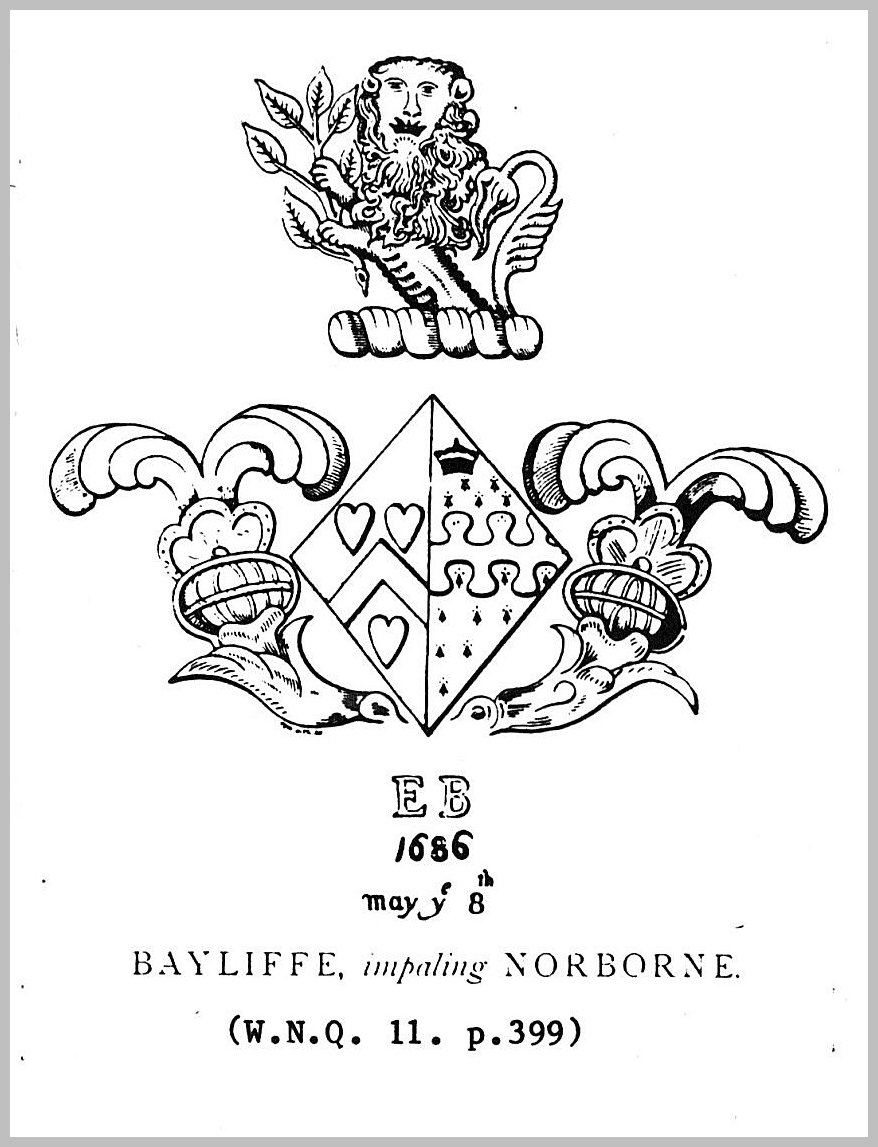
(Wiltshire Notes and Queries Vol.2 facing p.399) |
||
| Section 4 | ||
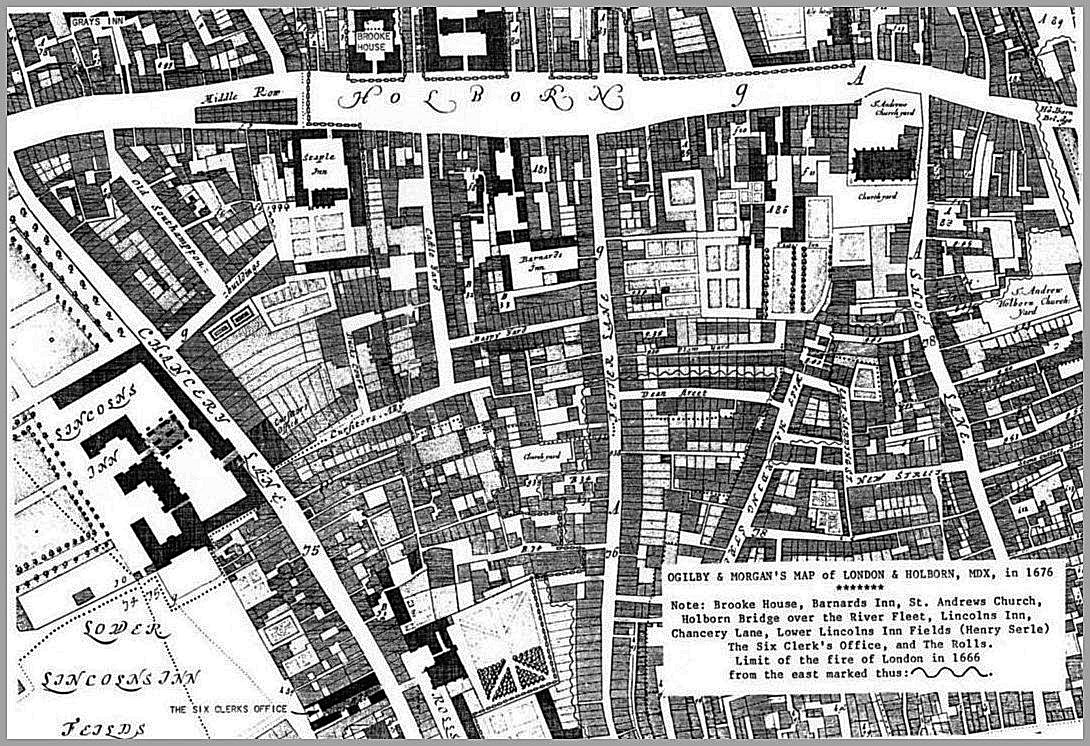
(The A to Z of Restoration London. Hyde / Fisher / Cline. 1992) |
||
| Section 5 | ||
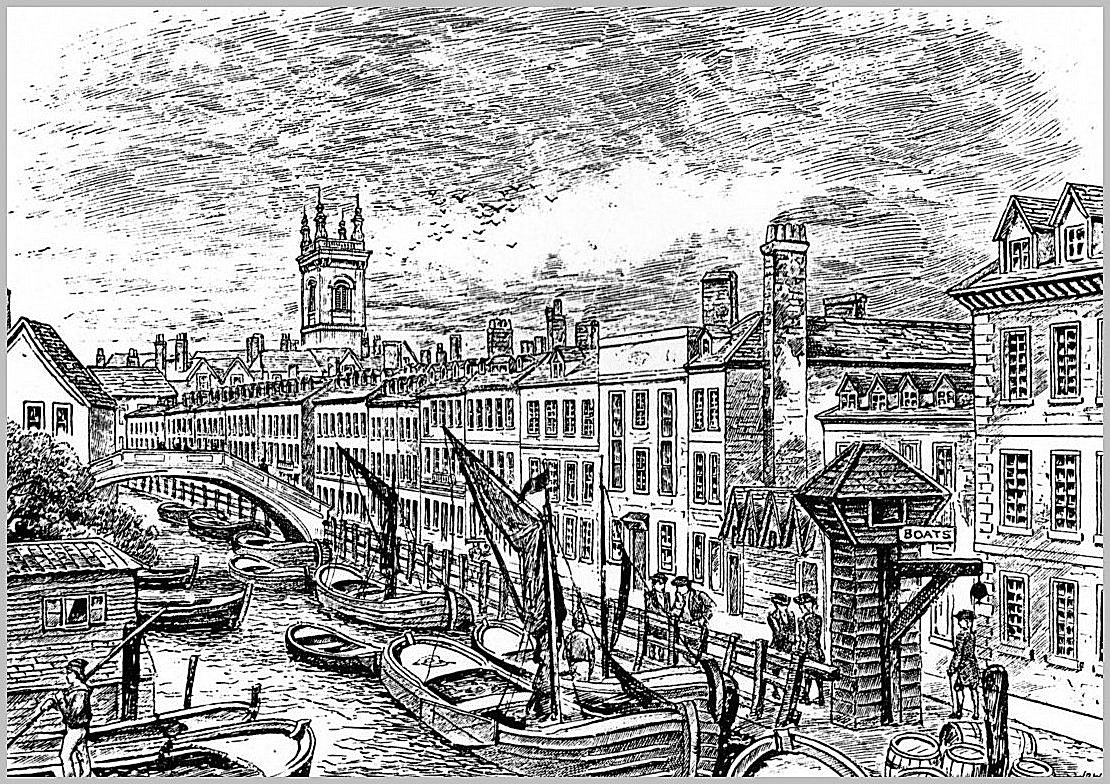
(Church of St. Andrew's Holborn in background) |
||
| Section 6 | ||
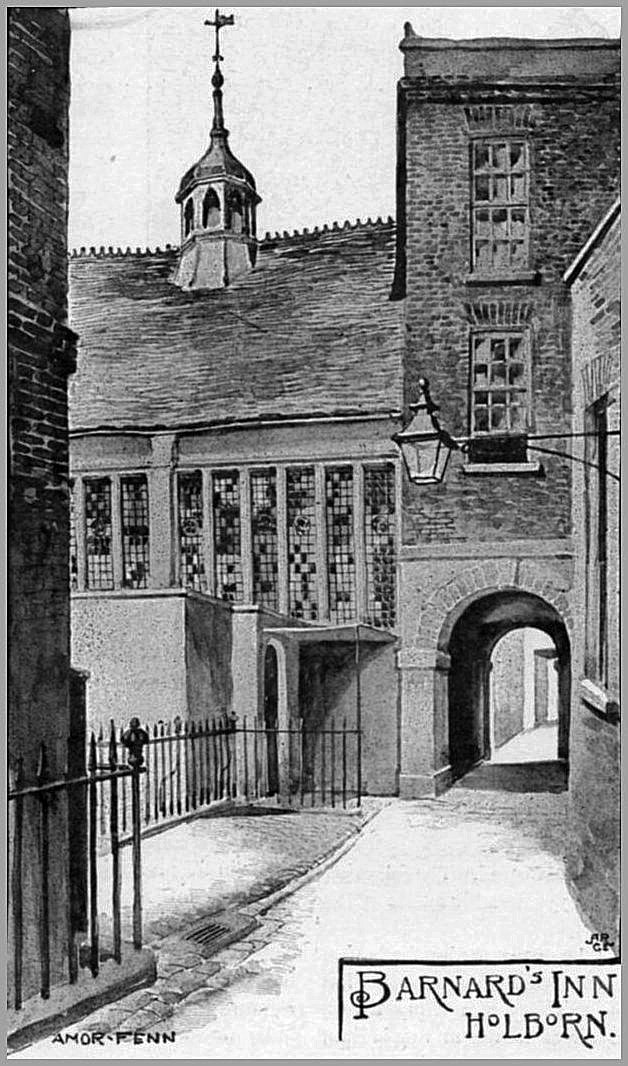
(from "The Romance of London" E.Oliver circa 1900 p.45) |
||
| Section 7 | ||
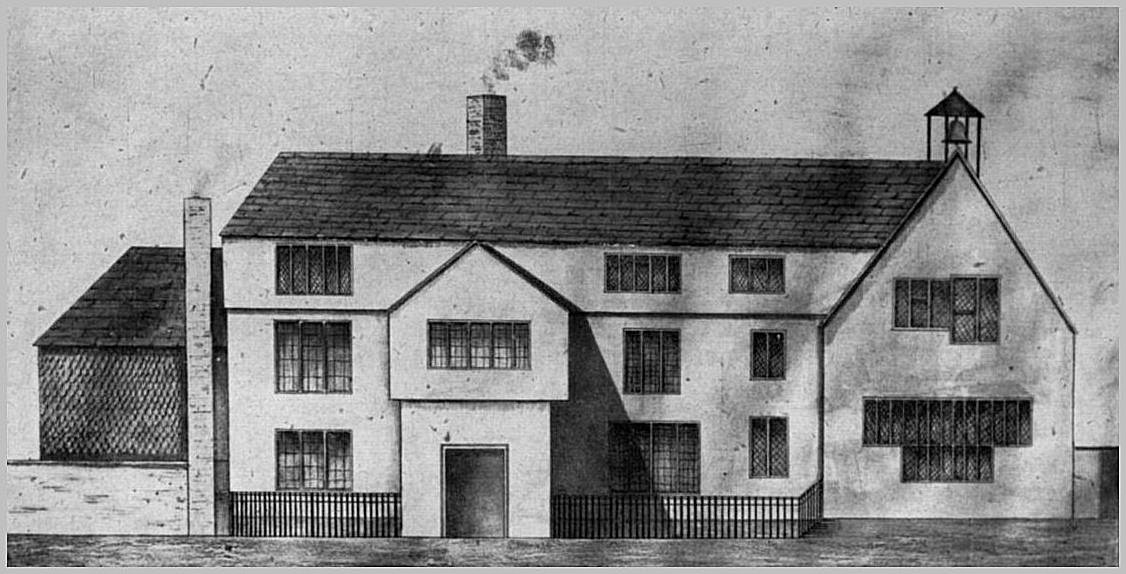
(from "A History of Marlborough Grammar School" A.R.Stedman. 1945 facing p.9) |
||
| Section 8 | ||
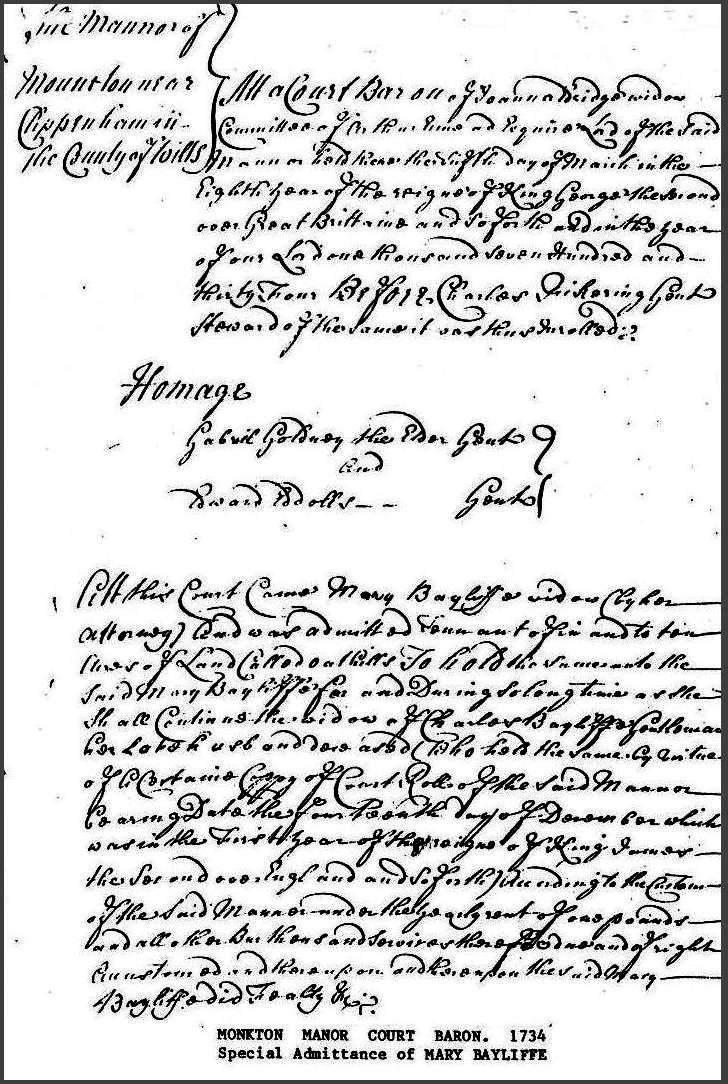
Special Admittance of Mary Bayliffe. Chippenham T.C. Archive 1734 |
||
| Section 9 | ||
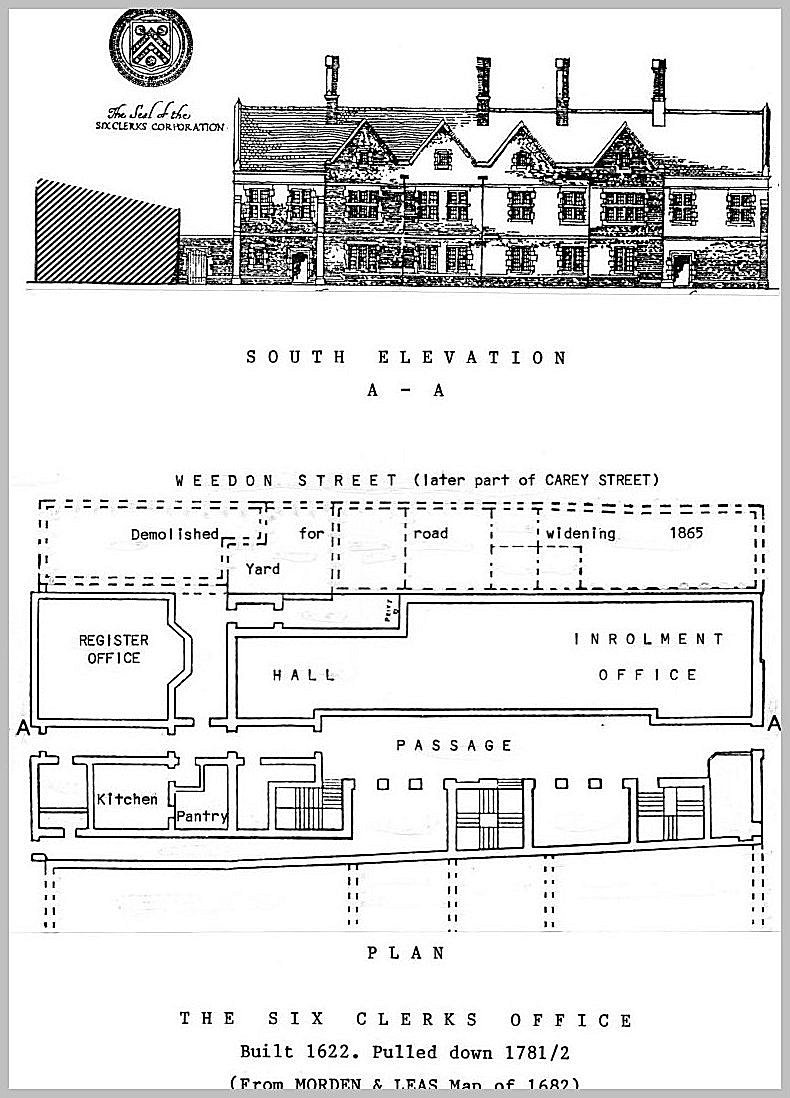
(Handbook of The Law Society 1938 facing p.98) |
||
| Section 10 | ||
| ||
|
|
||
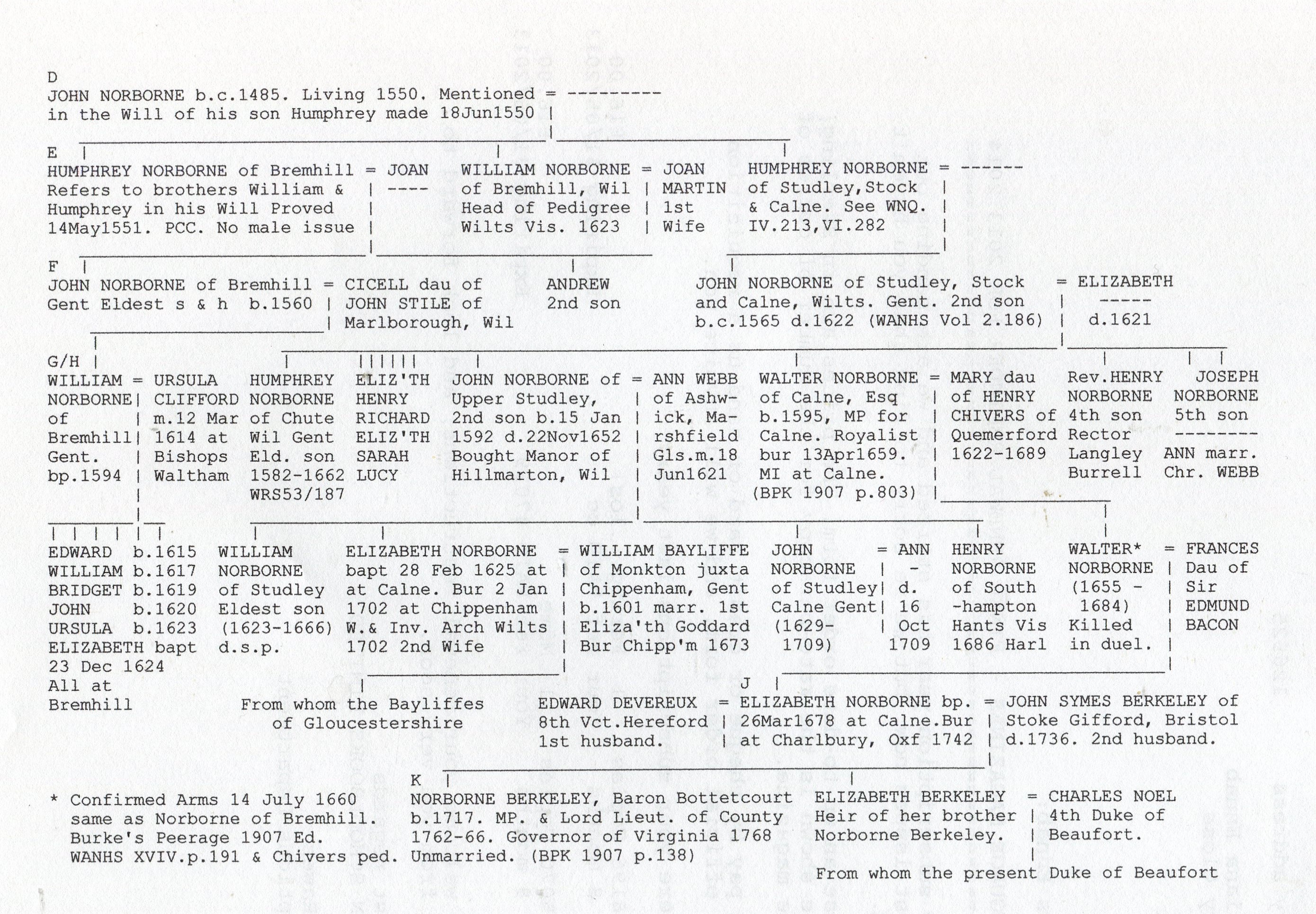
| Section 11 | ||||
| ||||
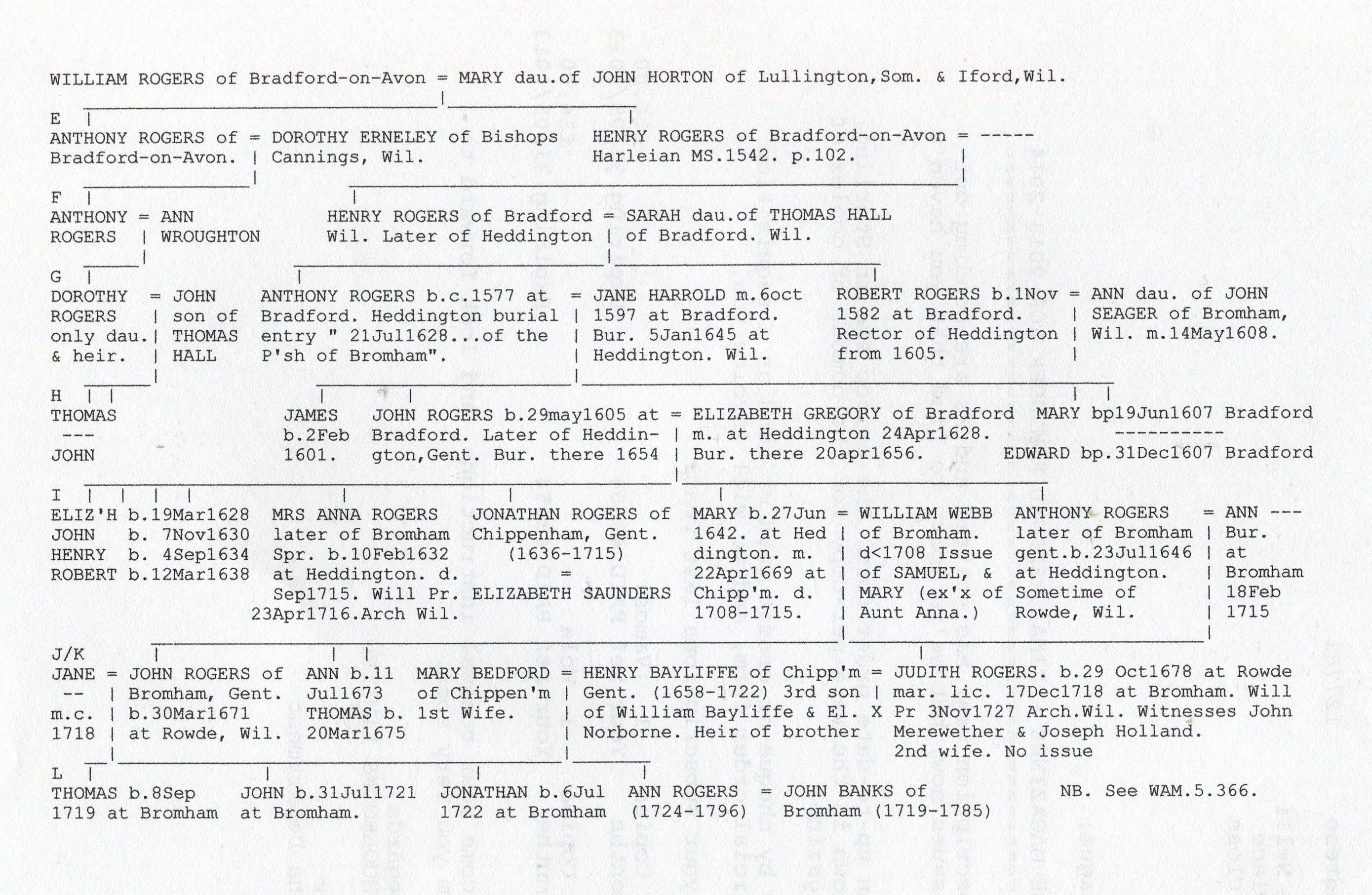
| Section 12 | ||
|
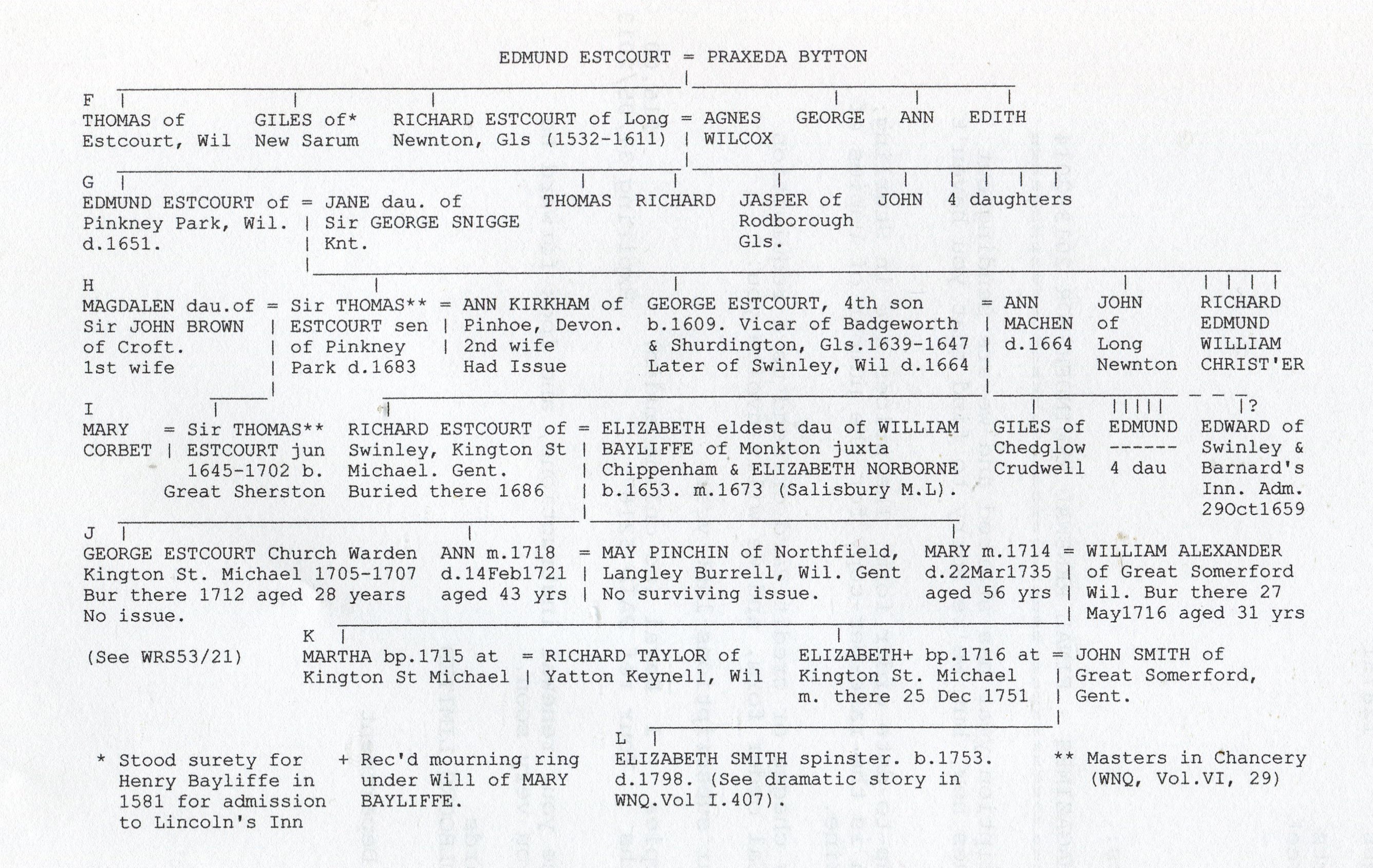
| Section 13 | ||
|
[Connections to HOY of Warwick, London, & Kingston, Jamaica.
SEARLE of London
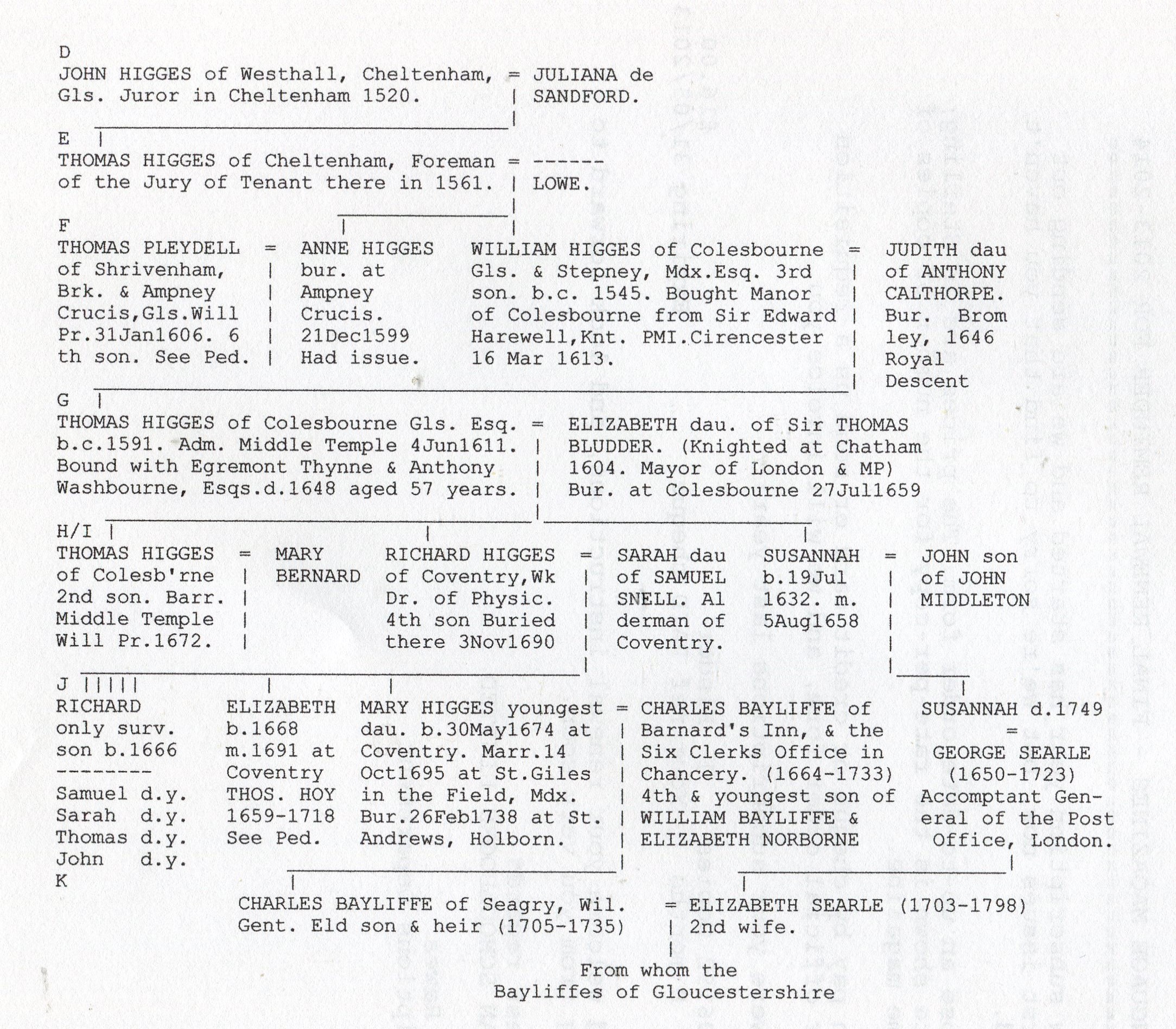
|
||
| Section 14 | ||
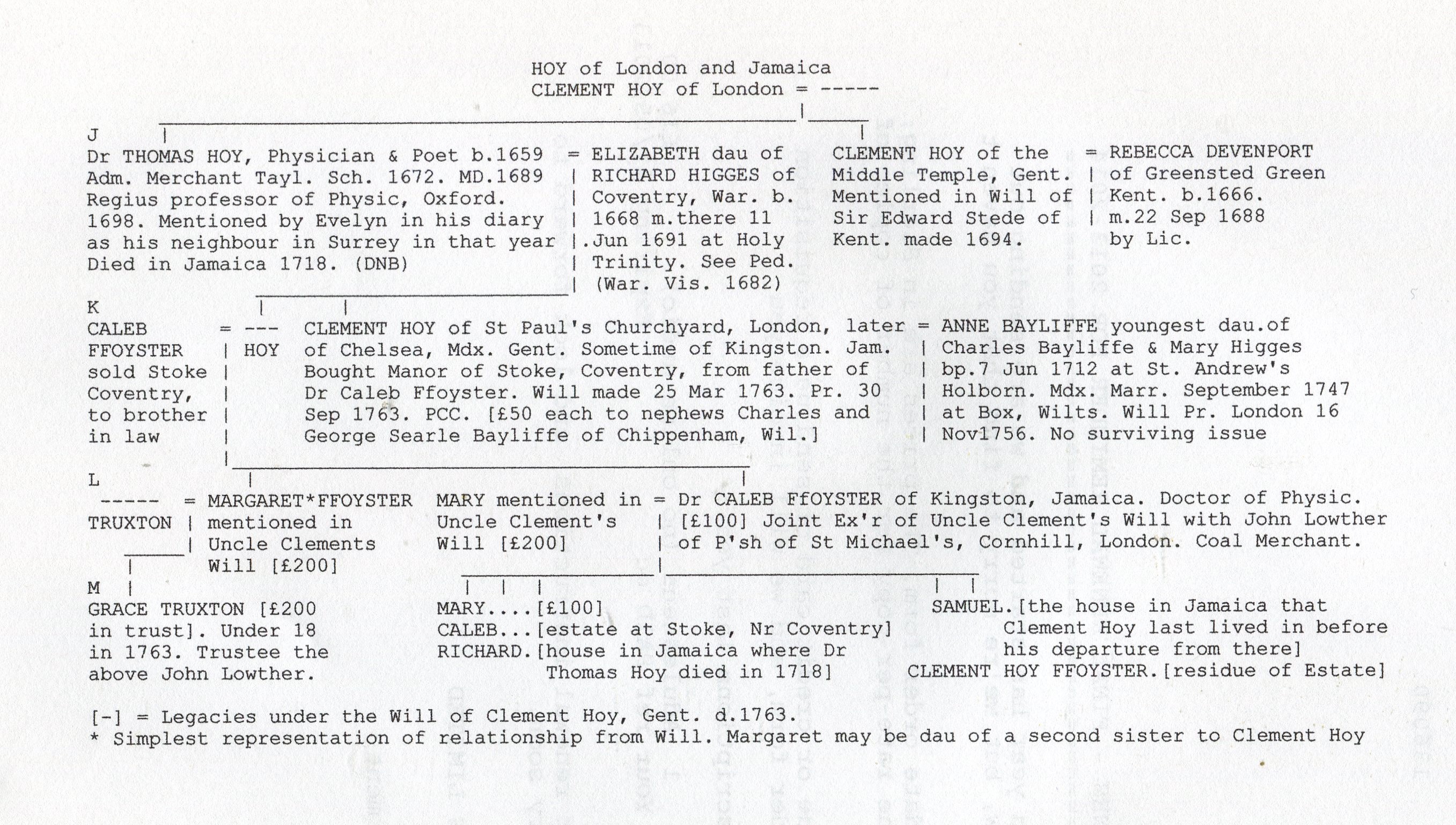
|
||
| Section 15 | ||
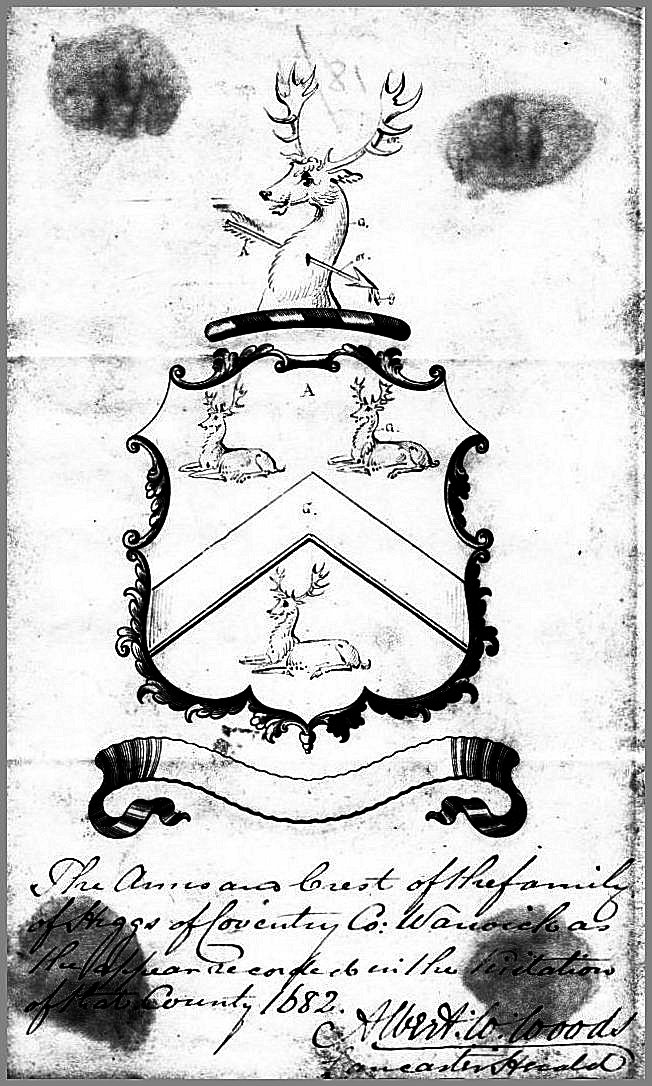
| ||
| Section 16 | ||
|
Notes and Sources 1 Wiltshire and Swindon History Centre. WRO, 130/48a; 811/7 2 C.W. Brooks "The Admission Registers of Barnard's Inn" 1995 p.115; Librarian, Grays Inn. 3 "Wiltshire Notes & Queries" Vol.2 p.238 4 Harleian "Visitation of Gloucestershire 1682/3" Vol.21 pp.20-22 5 The National Archives, C24/1447. 6020 Chancery Proceedings 6 "Gentleman's Magazine" 11 June 1733 p.326 [copies at Gloucester Record Office] 7 Law Society "Handbook of the Law Society" 1938 pp.94-112 8 W. Miller Higges "History of the Higges Family" 1933 p.382 9 Coventry Record Office. COV, 263/5 10 Ibid. COV, 214/1/26-30 11 J. Foster "London Marriage Licences 1521-1869" p.102 12 G. Baker "History of Northampton" 1822 Vol.1 p.10 13 The National Archives, C54/4891 No.11 Chancery Proceedings 14 Wiltshire and Swindon History Centre, WRO, 490/698 15 Ibid. WRO, 130/48a 16 One yardland = about 30 acres. 17 The National Archives, PCC Prob.11/660 ff.45,46 18 Chippenham Town Council, Archive 1734 19 The National Archives, PCC Prob.11/687. 1738 20 London Marriage Licence & Bond- 24 February 1734/5. Trade Directory 1736. 21 The National Archives, C11/371/47. 8 May 1735; C11/1115/13 & C11/1118/30. 22 The National Archives, I.R. 17/9 23 The National Archives, PCC Prob.11/858 ff.166-167 24 The National Archives, PCC Prob.11/820 f.11 25 "Wiltshire Record Society" Vol.11 p.143 26 The National Archives, C11/1118/30 1755 Chancery Proceedings 27 "Trade Directories" Various years and G.A.H. White "Chippenham in Bygone Days" 1924 pp.27,33. 28 The National Archives, PCC Prob.11/687 ff.223,224 29 The National Archives, PCC Prob.11/891 ff.366,367 30 "Dictionary of National Biography" Clement Hoy 31 The National Archives, PCC Prob.11/825 f.371
|
||
| NOTE: My thanks are due to Julian Rawes for his input and constructing this web site, and Alan Merryweather for support and proof reading. Bryant G Bayliffe. 1 March 2009 | ||
|
|
||