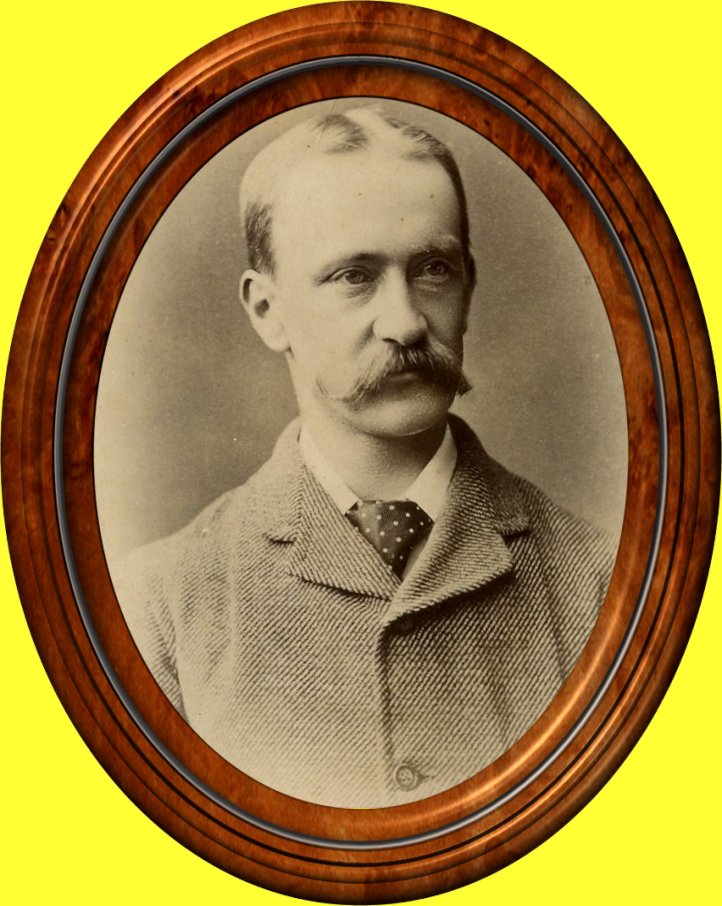
Letters and Documents relating to Col. Edward Glennie R.E., 1851-1921.
Compiled by Donald Hazelton of Arizona, 1997.

Col. Edward Glennie R.E.
1851 - 1921

This material was gathered together and arranged by Donald Hazelton and it is to him that this work should be registered. Donald is the nephew of Hope Hazelton, who kindly donated a copy of this work to my late father Bernard Rawes of Cheltenham, in 1998. It is a transcript of some documents and letters relating to Edward Glennie (The originals are with a relation Geoffrey Hazelton).

Both Hope Hazelton is Edward Glennie's grandchild through her mother Gertrude, Edward's daughter. Edward married Alice Scudamore. Francis Curteis Rawes married Edward's sister, Emma Octavia.

The account starts with Edward's private account of the Glennie family addressed to his grandchildren. This is followed by a section dealing with an autobiography of his background and early life. Next are two letters and lastly, histories of the Glennie and Hoare surnames.

Published here by Julian Rawes and Bryant Bayliffe, 2009.

A short account of my life
[Pages one:]
My Dear Grand children:
Possibly you will be interested in knowing some things about your grandfather and I therefore purpose to write from time to time short stories about matters connected with my life.

To begin at the beginning I will tell you that my father was Frederick Glennie. He was one of twelve sons of Dr. William Glennie. Who had also one daughter Isabella. About whom I may have more to say. Dr. William Glennie's father was John Glennie who in 1775 held a very high post in the University of Aberdeen. He also had a very large family. As far as I can make out his father and ancestors had lived for many generations at Mary Coulter on Deeside not far from Balmoral as farmers or ministers in the Scotts Church. From information given to me from two of my father's 1st. Cousins the Misses Glennie of the Galleries, Skine Road, Aberdeen. The family was considered to belong to the MacLean clan (which clan owing to their participation in the Old and Young Pretenders attempts in 1715 and 1745 was proscribed and its members dispersed by emigration to Ulster and Canada).

[Page two:]
William Glennie left Aberdeen and settled down at Dulwich, Surrey which was then a quiet little village surrounded by hills thickly wooded and the haunt of numerous gypsies (hence the name Gypsy Hill given to part of this country). He established a school which was of high repute and amongst his pupils was Lord Byron, Lord Holland, Sir Donald McLeod (a noted Governor of the Punjab) and other men of note. He was granted the degree of Dr. (Dr. Of laws or of divinity?) by the Aberdeen University on account of his eminent scholarship (Classics, English Literature + ). He married a Miss Mary Gardener of Edinburgh who was closely connected with the Dundas family, Sir Ralph Abercrombie &.

A tradition of the family is that we descend from the Bruces. One story I have heard about this is that Robert Bruce wished to send a daughter of his to Bruce castle, Tottenham (about which I shall have more to say) and asked one of his esquires a Glennie to escort her to London. He carried out his mission so successfully that on his return to Scotland Robert Bruce gave him a Niece (a Bruce and a ward of his) to marry. Sir Walter Scott in his "Tales of a Grandfather"1

[Pages three:]
does mention an esquire Glennie as being a follower of Robert Bruce.

My father was educated together with his younger brothers in his father's school. He was one of the younger sons. As each grew up they entered different professions. As clergymen doctors, and two joined the Navy (William (the 2nd. Son) and George (who died young of wounds received at the attack on Algiers)2.

In 1824 when my father was 15 years of age, #his elder brother William (who then was on half pay from the Navy) undertook on behalf of an English company to lead a mining expedition to Mexico, to work (for the company) a mine at Real del Monte and any other mine they might thereafter obtain. William took two of his brothers to help him my father Frederick and my uncle Robert Gavin.

The expedition left Falmouth? in two sailing ships (brigs) carrying about 200 Cornish miners and some of the families of these. One ship, in which were the three brothers was wrecked on an uncharted reef on the south coast of Cuba. But all passengers and crew were saved and all reached Mexico safely and started work on the mines. My father was born the 14th Nov. 1809. He went to Mexico in 1824 with the second batch of English emigrants to that country after the immigration of men not Spanish was allowed into that country the first batch having gone in 1822.

[Page four:]
When my father arrived in Mexico that country was still a Spanish colony. But shortly afterwards a movement was started which ended in the Mexicans becoming independent, and proclaiming a republic on the lines of the Constitution of The United States. But the struggle lasted a few years. Without affecting the mines to any extent nor to the activities of the brothers in carrying out their instructions. #These included the exploration of the country to ascertain in what direction the company's activities might be extended. Uncle William seems to have traveled over much of Mexico. And often in the less extended trips his brothers accompanied him and assisted him. These expeditions included the search of the Po**** **** & other mountains and were always combined with sport; deer being abundant.

William however was called back for a term of service in the R.N. I think Uncle Gavin replaced him as the agent to the company I don't know ***** much as to what happened. My father seems to have had charge and estates for several Mexican

# This requires verification. Was the independence of Mexico established before 1824?3 ***** Uncle William *** *** a ** and of *********)

[Page five:]
proprietors for some years. Including the world famous mine at Guanajuato. Where he was employed when he married my mother. Charlotte Celastine Dupreé She was the youngest daughter of Dr. Laurout Eusebe Dupreé (Vicomte de Mornas in the old pre-revolution regime). He was born during the "Terror" of that revolution and just escaped the fate of his grandfather and father. He was the youngest of three brothers was educated at Valence (his native town) and Paris, distinguished himself in his studies and obtained a doctors diploma at a very early age. He married Anne Constantine of Monte*i**ard it seems to have caused some friction in the family as she was a Protestant and did not belong to the old nobility. Possibly this and his love for an active out-door work induced him to emigrate and he went to Louisiana formally a French colony but then, as now, forming part of the United States of America. Making New Orleans his headquarters he seems to have traveled a good deal in that State. But eventually he established himself at Vera Cruz. Where his conduct during a dreadful epidemic of yellow fever and cholera was so noble that the city authorities and inhabitants united in a demonstration of thankfulness towards him. He traveled a great deal over Mexico, his reputation as a doctor extending from Vera Cruz.

[Page six:]
He had three daughters but one Louise died young. His eldest daughter Josephine married a prosperous man Charles T. Kauffman a native I believe of Holstein but naturalized English, who previously to settling down in Mexico he traveled a good deal visiting Bombay Hong Kong, the Philippine Islands and the United States. He was a merchant in the City of Mexico and in partnership with some Germans.

The second surviving daughter was Charlotte Celeste my mother. At the time of his marriage my father had accumulated a large fortune, and for some time seems to have lived at times at Guanaxuato, and at times in Mexico itself for when the United States made war on Mexico and captured the City of Mexico. Capt. Robert Lee (Later General Lee who commanded the Confederate forces) and Capt. Beauregard were billeted in his house which led to mutual friendship between them which lasted all my father's life.

[Page seven:]
My elder brothers and sisters, Vis Frederick, Anna Charloto Laura, Helena were born at Guanuaxato, and also Leonid who died in infancy.

My father being satisfied with what he possessed contemplated retiring and settling in Europe near Florence or in the Pyrenees. Prompted to do so by his love of mountains and his intimacy * * * * with a Signor Placci, a wealthy Italian who represented the Duchy of Tuscany in Mexico. A man who's hobbies (botany, entomology, painting and music) were in agreement to his and Mr. Adrian Dasté, a Basque who shared in their pursuits and in sports of all sorts. My father invested part of his fortune in purchasing a partnership with his brother Robert Gavin and Mr. Dasté a large estate in the State of Micoucon from the Guerrers family. The rest he confided to my Uncle Charles Kauffman's partner to be sent to England.

This partner, a German (of the name of Drunida I think) had charge of the business at Vera Cruz. He suddenly absconded from the country with my father's money and a large sum belonging to my uncle Charles. And nothing more was heard of the scoundrel.

As for the Michoucon estate, it is in a part of the country which was always (and is now) very unsafe

[Page eight:]
from brigandage. Mr. Dasté for some time managed to get some produce from it. Cattle, cotton, coffee, timber and dye woods. But eventually was after a sever fight in which several of his loyal servants lost their lives and he himself covered with wounds had to escape and since the estate has been in the hands of the brigands.

Owing to the loss of his fortune my father had to start again work as a mining engineer and he got * work in a mine on the side of the * izaba mountain at Pasco Nacional. Not far distant from the town of Jalapa (whence the drug Jalap comes) It was a very isolated spot known as Pasco Nacional * some 12,000 above the sea, I suppose the house was similar to the ordinary "hacienda" type. The rooms being dispersed around a couple of "patios" courtyards open to the sky surrounded by a verandah from which the rooms were entered by doors. Few if any windows pierced the external walls. The roof was flat and there was a tower at one corner from which the approaches to the house and mine were watched day and night by some of the men employed as escort for the protection of the place.

In March 1851, when my arrival on the scene was expected, my Grandfather came out with my Grand mother and Aunt Josephine (who was always called Tia).

END OF THESE PAPERS.
[Notes:]
  1. From a 1950s gazetteer-
    Bruce Grove, sta, L.N.E., NE Middlesex, 4m S of Enfield.
    Bruce Castle stands on the site of house which belonged to the father of King Robert the Bruce. Bruce Castle Park is a public recreation ground.
  2. "George (who died young of wounds received at the attack on Algiers)" - See Glennie file. 1816, August 26. Allied bombardment of Algiers. Following a succession of outrages against British shipping and subjects, a squadron under Admiral Edward Pellew, Lord Exmouth destroyed the port fortifications and the Algerian fleet in a 9-hour engagement. A Dutch squadron under Admiral Theodore F. Van der Capellen assisted. The Algerians surrendered some 3,000 European prisoners.
  3. "Was the independence of Mexico established before 1824?" - Mexican independence from Spain was proclaimed 1821, February 24 ( the Peace of Cordova), no longer restricted to trading only with Spain, Mexico immediately opened her doors to foreign trade. During the early years of Mexico's War for Independence, insurgent groups were active in Hidalgo. At the time of independence, Hidalgo's territory was part of the Province of Mexico. Mining activities were renewed in the region shortly after independence with the founding of the Real del Monte Company, base in London. On January 15, 1869, following the restoration of the Republic, Hidalgo became a state.

    Author Randall, Robert W., 1925-
    Title: REAL DEL MONTE: A BRITISH MINING VENTURE IN MEXICO, by Robert W. Randall
    Publ.: Austin, Published for the Institute of Latin American Studies
    Info: by the University of Texas Press [1972]

    Descript. xvi, 257 p. illus. 23 cm
    Series: Latin American monographs, no. 26
    Latin American monographs (University of Texas at Austin.
    Institute of Latin American Studies) no. 26
    Note Based on thesis, Harvard University
    Bibliography: p. [239]-247
    subject Company of Adventurers in the Mines of Real del Monte
    78037944
    0292770006

"Established in London in 1824, the British Real del Monte Company was lead by men convinced that the application of English capitol and technology to the ancient, famous, and largely ruined silver mines of the former Spanish colony, would not only reap them a handsome profit, but also would have a salutary effect on the new nation's mining industry. The center of the firm's activities was the property owned by Pedro Romero de Terreross, the third Count of Regla, in Real del Monte, one of the oldest and best known silver districts of Mexico. During the twenty five years that the English concern existed, its overseas expenditure totaled $ 16,218,490 and its income but $ 11,139,207. The loss of more than $5 million makes it clear that the history of the British Real del Monte is in one sense the story of a financial disaster. Was it in the fullest sense of the word a failure? The Mexican firm that bought out the English company in 1849 proved to be a profitable endeavor. Under the United States Smelting, Mining and Refining Company, which acquired controlling interest in the stock, the property yielded one of the most spectacular and sustained bonanzas in the history of Mexican silver mining. And .. Mexican Government continues to operate the centuries old mines at no loss.... the foundation for that series of successful mining enterprises at Real del Monte was built between 1824 and 1849".

Note:
REAL DEL MONTE: A BRITISH MINING VENTURE IN MEXICO makes no mention of the name Glennie of ship a ship wreck off Cuba.

Dr. Laurout Eusebe Dupreé (Vicomte de Mornas in the old pre-revolution regime) ... was educated at Valence (his native town) - Valence on the Rhone river, in Drome.

US - Mexican War, 1846-1848

"Capt. Robert Lee (Later General Lee who commanded the Confederate forces) and Capt. Beauregard were billeted in his house" -
1847, April 18. Battle of Cerro Gordo. Santa Anna, with more than 12,000 men, held the fortified defile, whose flanks were seemingly impregnable. Scott's engineers (who included Captain Robert E. Lee and Lieutenant Pierre G.T. Beauregard) discovered a flanking mountain trail over which Scott hurried his main body .... After a sharp fight the Mexicans were completely routed.... September, 14. Capture of Mexico City ......

1848, February 2, Treaty of Guadalupe Hidalgo. This confirmed the southern boundary of Texas and transferred to the United States the regions now comprising California, Nevada, Utah, most of Arizona and New Mexico and parts of Colorado and Wyoming. The US paid Mexico $15 million .... evacuated Mexico City June 12, and Vera Cruz July 4, 1848

A short account of my life
Transcript of the 2nd of Edward Glennie's papers detailing his back ground and early life.
Note: the papers were not necessarily written in this order, and that there may be more papers as yet undiscovered.
[Page one:]
I think that a short account of my life may be of interest to my children though it has not been an eventful one. Yet there have been some interesting episodes in it.

My father Frederick Glennie was one of the younger sons of Dr. William Glennie of Dulwich to which place he had moved from Aberdeen. Dr. W. Glennie had twelve sons and one daughter Isabella married first to Dr. Thomson MD. Of Edinbourgh (a cousin) and then to Mr. Crafton Smith of Fiume, Austria. In the sequel I shall have to refer to her.

When my father was about 19 he went to Mexico with his elder brothers William a Lt. RN (on half pay) & Robert Gavin with a party some hundred or more strong of Cornish miners in the employ of an English mining company of which my uncle William was in command. The expedition sailed in two barques. One of which was wreaked on the coast of Cuba but the whole eventually reached Mexico and exploited the silver mines at Real Del Monte. But a good deal of the brothers time was occupied in prospecting on behalf of the company over a large area of Mexico for likely mines, so that they became personally acquainted with large area of the country. William returned to England leaving his brothers in charge of the works and at times continued his Navel career but eventually worked under Brunl as an engineer on the G.W. railway, he was employed as an un' **** engineer with Simms on the Box Tunnel and on construction on the line

[Page two:]
from the tunnel to Saltash. He was a first rate carpenter and designed under Brunel's direction the fine wooden bridges in South Devon. This was done principally by constructing models to scale of each bridge which models were made by uncle William. He died of sunstroke when erecting the Saltash Bridge. (See Glennie file)

Robert Gavin and Frederick Glennie continued in the Real Del Monte Company for some time but their sporting proclivities led them to absent themselves for a twelve month from the work during which time they wandered shooting in the mountains and forest with an Indian servant. Their posts having been filled up on their return they obtained employment under wealthy Mexicans near Guanaxuato managing mines and landed property. They did so successfully for their employers and for themselves. As both brothers made considerable fortunes. About 1840 my father after 3 years engagement married Charlotte Dupré. The second daughter of Dr. Laurout Dupré (Viconete De Moranas) and had the following children - Charlotte (Guiera). Charles Frederick. Laura, Helina, Leonid (died in childhood) Edward (my self) Walter Glenthorne, Emma, Constance (died in infancy)

About 1849 my father left Guanaxuato and took charge of a mine (I think a private venture) at Paso Nacional high up on the slopes of the Orizaba. It was a very lonely spot and unsafe especially as

[Page three:]
many of the work people were bad characters. My Grandfather & grandmother Dupré lived at times with my father at Pasco Nacional and also my aunt Madam Kauffman (Tia) My father made a short visit to England in 1850 and on his return was one of the few passengers who escaped from the burning wreck of the R.M.S. Amazon on Jan 12 1851. (Of which you can read the whole account in the book written about it and published by S.P.C.K. which is amongst my books)

During his absence from Mexico or soon after the English community being dissatisfied with the then Consul General petitioned the Foreign Office to appoint my father Consul and this was done. I was born at Pasco Nacional on March 13 1851 and for the event my grandfather, grandmother, and aunt were at Pasco Nacional. A few days after I was born these three were sitting on the flat roof of the house one evening close to an elevated tower on which an armed guard was posted each night. They overheard the guard discussing a plan for massacring the whole family and looting the place. The scheme was to be carried out on the return of the escort to a convoy, which was to return the next evening. There were some few dependable men who were sent to discover the extent of the conspiracy and these found that not only the armed guard to the mine were to attack us but bands of robbers who infested

[Page four:]
the district were to arrive. So it was decided to leave the place as quickly as possible especially as my father had been appointed consul at Mexico.

The whole family and servants traveled in a diligence, a large carriage suspended on C springs - able to hold 12 inside and a similar number above with capacious boot behind for luggage at the back & more luggage on the top. Driven by eight mules two leading, then four abreast and two to the pole. Most probably the driver was an American.

How we were allowed to leave the place I don't know but probably the conspirators never imagined we would leave the place three days after my birth and our servants who were loyal to us were able to manage our flight unknown to the guard who lived outside

Our destination was Jalapa. Which however we did not reach without adventure as a big whirlwind chased us closing the way for some distance. It was a huge tornado which as it rushed along uprooted trees, knocked down walls & cattle. However the driver knew we were approaching a large building along the wall and if we could get under shelter of the walls, we would avoid being upset. By deed of galloping as hard as the mules could the building was reached just in time but in turning off the road the front wheels got detached from the body of the carriage which was upset. Luckily no one was seriously hurt. The whirlwind passed on. At Jalapa we made a short stay and thence moved to the City of Mexico where my father assumed his work as consul.

[Page five:]
I stated before that my father had amassed a comfortable fortune and it had been his wish to leave Mexico and settle in Florence. He was passionably fond of art, was a very fine artist in water colours, a good performer on the flute and had a good voice. One of his great friends was a Mr. Placi who came from Florence & had a fine house there (his family still lives there) but he was prevailed upon to stay and invest most of his money in a German firm which failed shortly and all the money was lost. He also invested a small portion of his fortune in the purchase of a third of the Hacienda of Milpillas His brother Gavin purchasing another third and a friend M. Adrian Daste (a Basque) the other third.

The extent of ground so purchased by my father was about 20 miles in length & 11 miles in width and raised in elevation some 900 to 11,00 feet above sea level. The lower part of the state being on the river Babas down which trunks could be floated to the Pacific. This purchase was also unproductive for Dasté who managed the combined haciendas was driven out by bandits after a stiff fight in which most of his loyal men were killed & he himself left on the field as dead with a score of wounds. The buildings, chapel too were destroyed and the place became the rendezvous of all the outlaws of the country & and remained so until I returned to Mexico in l882

END OF THESE PAPERS.

A visit to the Dupré's when Edward Glennie was 13
[Page one:]
We had been, Glen and I, a year at Bruce Castle, when the Summer Holidays of l 864 approached. Mrs. Devas, with whom we generally passed our holiday in St. Lenards, was not well able to extend her generous hospitality that year and friends felt that two young boys would have a very dull time, with no companions so she eagerly accepted Tia's proposal that we should pass the holidays with our cousins at Valence. Tia writing from Mexico, told Mrs. Divas that the month was arranged and that we were expected. So Mrs. Divas considered she had done all she need by engaging a Swiss governess to escort us to Valence to make us over there to the Duprés. The holidays began about the end of June and lasted two months.

So one evening in June we were met at London Bridge Station (neither Charring Cross nor Cannon St. stations existed then I think) by Mademoiselle (?) a prim ill tempered woman of some 35 years of age who (seemed bored and annoyed in having the bother of looking after us. She had a great number of compatriots to see her off and it was only when the train started that she had time to take any notice of us. I do not remember much of the journey to Paris, so I suppose that though we traveled 3rd class we slept soundly enough till we reached Paris early the next morning and then discovered that our luggage had been left behind.

[Page two:]
We passed an agreeable day in Paris with a compatriot of Mademoiselle. Who took the needful steps to have our luggage sent on (& eventually we got our box just before we returned to England). In the Evening, we started again by the P.L.M. for Valence and all went off smoothly as far as Lyons when Mademoiselle discovered that she would have to change onto a train for Geneva and we passed by the train in which we had come to Valence. However with much show of temper she took a ticket to Valence and back to Lyons. (As the train stopped at Lyons a considerable time she was able to do this) about 5am. We arrived at Valence "Japrenard" Dupré la Loise's house being close to the station we were soon at the door of the house, trying to awaken the inmates. Which we succeeded at length, thanks to Mademoiselle's importunity as she had to catch her train within an hour of our arrival.

The cook appeared first and recognized us as we had passed three months in the house in 1860 and soon after Dr. Dupré la Loise came down to see what was up. He was greatly amused & surprised for neither he nor any of the family had heard of our coming. His daughter Louise (married to Dr. Odon Gailland) who managed the household was away in the Cevennes mountains, staying up at Urbillac with her sister Mrs. Raphael Gailland and old Dr. Dupré la Loise about to go to visit some property away from Valence.

[Page three:]
However he welcomed us most heartily. The cook had some splendid fruits just plucked from the extensive and noted orchards of Japrenard, so that Mad'lle went off to catch her train in better humour than she had been for some hours.

The best thing you can do is to join the party at Urbillac said old Dr. Dupre' la Loise. It is high up in the mountains therefore not as hot as this. So we will catch the next train to Lyons & stop at Tourmon (where I have some business to transact) & then go up the mountains by diligence to La Mastre. So by 8am we were again on the move. We reached Tourmon about 10am and after a dinner á la fomchette took our places in the coupé of the diligence in the company of a stout bucolic gentleman who turned out to be the Mayor of a small commune adjoining that of Lamertre and who proved to be an agreeable cornpanion.

Dupré la Loise had sent a telegram to Raphael Gailland but if it had miscarried the Mayor promised he would see we were taken charge of by some one at Lamertre.

At Tourmon we had time to witness some jousting & other sports on the Rhone. Most interesting to watch as it exhibited great skill and pluck on the part of the men. The Rhone, being a very rapid river.

The drive from Tourmon to Lamertre was a beautiful one. The road ascends a steep valley with a fine stream

[Page four:]
Flowing rapidly and at times tumbling over cascades. The hill sides, when not covered by vineyards are we wooded and at close intervals comfortable farmsteads surrounded by orchards delighted the eyes. There were numerous wayside inns. As the road was steep and weather hot the driver had always the excuse of resting the horses whilst he sampled the wine an operation in which he was ably assisted by the Mayor. So it was late when we reached the market place of La Mastre. As we did so the Mayor pointing out a bearded man said " Voila Mr. Raphael Gailland". As the last time we had seen him ~ then only for a few minutes Raphael Gailland was clean-shaven we would not have recognized him. He gave us a hearty welcome "Now for your luggage. What no luggage! Well it is just as well. These sorts of clothes are an encumbrance. You are going to live in the mountains so dress as our mountain boy's dress. We have time to fit you out" So presently we emerged from a shop dressed in blue cotton trousers & blouse straw hats. (We rebelled against sabots he would have us wear but got us some rough leather boots.

We ….

End of script!

Notes:
Glen = Walter Glenthorn Glennie?

A letter from Jellalabad. October 1, 1879
[Page one:]
My Dear Mr.Hamilton
I have only time to write to
thank you for the trouble you had
about Veterinary college.
Your letter reached me yesterday
I am now busy in making a
defensible post inside the city of
Jellalabad. The labourers I have
to do the work only speak Pushta or
Persian neither of which I know
so that I have to sit over the work
to prevent any mistake and therefore
have little time for writing.
I reached Persharin just in time
to advance with the Bengal ** *****
who formed part of advanced guard
in the Ali Masjid engagement
our work consisted I making the
ground passable for the R.H.A. we were
under fire a short time but


[Page two:]
but happily the few shells that
dropped amongst us did not
explode. We had four days
hard work marching through the
pass as almost at every mile
we had to repair road or rather
convert a torrent into a road
passable by R.H.A. In places
the horses had to be unharnessed
and Sappers had to pull or lower
the guns by means of ropes. All the
the food we had was what we carried in
haversack from Jursrood (besides
a few pomegranates we "cooled" at
Alli Masjid. The weather was & has
up to date glorious though at
first bitterly cold bivouacking on
top of mountains. We remain at
that filthy Fort Dakka 3 weeks
of all desolate, nasty places I have
seen Dakka is the worst. Had we
Pushed on at once to Jellalabad
we would have been in time to meet
some of the Afghans retreating from
Peiwar but orders from Gov'T
[Page three:]
prevented that advance much against our General's wishes
Jellalabad is a small miserable town, ********
with a crumbling mud wall around it
which seems ready
to fall next earthquake. When first we came the bazaar
was far from full now new shops are opened daily and
already 3 enterprising box wallers have arrived from
Rawal pindi & Peshawar. Commissariats however have
not obtained the supplies they expected and which judging
from fertility of the plains of Jellalabad they should have
got. And no pressure what ever is being put on inhabitants
to produce them . The camels are consequently overworked
and already 25% have died from overwork, lack
of food ******. A cart road has been begun but
it will take a couple of months yet to finish
The Khyberici are a set of cowardly scoundrels; brutally
murdering & mutilating stragglers + and always becoming our allies
on approach of the smallest party. They are allowed to
go around armed to the teeth and they all have new
Enfield rifle (which they looted from Amir's armory) they are very good shots and are ******
active on hill side. People at Jelalabad are of a
more civilized type and apparently pleased with us,
they are now making lots of money.
We don't anticipate any great opposition on our way
to Kabul. We may have a skirmish at Jagdulak or Tezin
Pish Gory. Kindest regards to Mrs. Hamilton & the young ladies
& believe am
Yrs sinly
Edward Glennie
Jellalabad
10/1/79

A letter from Khandahar
[Page One:]

Sept, 3. 1880

My Dear Pico
We marched here on the 31st. Stopped
near the Shikarpor gate of the city
where breakfast was ready for us
the 7th. Fusiliers sent us out
a regular banquet for us officers
& the commissariat having made
ample provision for the soldiers
at 9.30 a.m. we advance to take
possession our camping ground
1½ miles from Kandahar (from where ***
I write to you) and of the underground
water channel which was to supply
our force with water. These were
reported to be in the enemy's
possession. The 24th. Infantry was followed by more artillery and the 2nd. High-
landers and rest of General Mc. Pherson's
brigade - we marched on camp &
enter without opposition but 24th. Was
pushed forward to reconnoiter - about
a mile or more shots were fired
from some orchards and before long

[Page two:]
crowds of enemy showed them selves
on top of mountain in our front -
there was heavy firing for some time
the 24th. were kept engaged until our camp
for the night had been arranged and
the necessary pickets posted - when
they were withdrawn - in the meantime
Genl. Gough & his cavalry brigade
escorted by the 15 Sikh Regiment
made a demonstration on our
left to make the enemy show his
strength - the enemy came on in great numbers
but happily the splendid
discipline & self reliance of the Sikhs
was such that they
not only kept off the great numbers
of Ghanis but sent them back with great
loss. As soon as our camp
was pitched the enemy's guns began
to play on us. We were within easy
artillery range so that their shells
& round shot fell in our camp
but happily did not do much harm
in fact I don't think any one was
hit except a groom - the enemy
showed signs of advancing toward us
[Page three:]
we had to leave our half eaten dinners
and prepare for action but
they, the enemy, only contented themselves with
firing at the 3rd. Brigade from such long distance
that little harm happened although
the firing was continued the whole night
At 6a.m. of the 1st. Genl. Roberts held
a council of war at 7am we all
had breakfast at 9am. all our guns began a cannonade which
was well answered by the enemy
whom we saw occupying a large village
about a mile to our front on a small
hill - the whole of the ground in front
was covered in orchards *******
by high walls - & cut up with irrigation
channels (happily dry). At
9.30 Genl. Mc. Pherson ordered the 2nd.
Gurkhas to advance on the village
the 92nd. Followed at first but
before long the whole of the Gurkhas
were extended on the left and 92nd.


[Page four:]
to the right - we were being fired at
from our front & our right so that
there was considerable noise of
whistling bullets from the high
vertical rocks all the shots were
re-echoed at first it was rather
difficult to keep men advancing
from each wall but by 9.40 we had
all warmed to the work and our
advance was a succession of
rushes from wall to wall the men only
stopping to fire their guns - by 9.50
the base of hill upon which village
is built was reached the Highlanders
marched in fixing bayonets headed
by their gallant Major White
lot of the men were wounded
and two officers Menzies & Stuart
Menzies in the thigh, he was placed
in a dark room by his men whilst
a stretcher was bought. Unhappily
the darkness of room hid a Ghengi
[Page five:]
who no sooner was Menzies left
in the room attacked him with
a sword and gave him a nasty
cut between the shoulder blades
some 50 men in the village gave
lot of trouble but the advance was
not delayed & we soon found ourselves
at the place I've marked hot corner
in sketch here the Ghengis made their
last stand and bullets came flying
about in great numbers we were
advancing along a dried charmel
to get protection from the fire of
marksmen on top of mountain
on our right but the bank of channel
was only 3 feet high and men were
deceived by some very thick brushwood
which they erroneously supposed was
sufficient cover so there were a
good many causalities here -
by this time the whole Brigade
was rather mixed up 92nd. still in
[Page six:]
the front but the long legged
Sikhs had got ahead of the
stumpy Gurkhas so as we
rounded the corner the 92.
And a few of the more active
Gurkhas were on the left going towards
enemy's artillery camp and 23rd. Pioneers
(Sikhs to the right towards the
Baba Wali Kotal followed by the
24th. 2 * and the screw guns firing
over 92. into camp -
the nature of ground here altered
and we found ourselves on a bare
bare pebbly slope without the slightest
cover. Our Brigadier had had
orders to stop there & and wait fir reinforcements
from 3rd. Brigade but as we were
so good progress he thought
better not to stop the troops after
a good resistance the Ghengi began to
fade away and soon a stream of
fugitives were seen issuing
[Page seven:]
from Baba Wali Kotal. These were cavalry
and Afghan regulars who had been posted
on the Kotal and in the ground in front
our 40 pounder guns fired on them without
much effect and unhappily prevented our
advance in pursuit of the enemy as
our own shells were bursting just in front of
us to prevent this Capt. Stratton head of the
signaling depart't was sent to signal to the guns to
stop firing and order the Bombay Cavalry to pursue
he was ordered to take two companies of the 23rd.
As escort but he was so confidant, that he
only two 72nd men as signalers and led the way by
some twenty paces he had not gone 100 yards when
a wounded Afghan got up and shot him dead
he was an exceedingly nice fellow and the cause of
the great success that has attended all signaling operations
in Afghanistan. Gov't has lost in him one of its best officers
by the last shot fired during the fight
the cavalry was not up to us till 3p.m. the fight
having ended at 12.30 and Ayub Khan's camp
captured at 1.30 We captured all A. Khan's
guns including the two guns we lost at *****
**** lots oftents and food and odds and ends
92nd. Lost         13 killed           46 wounded
2nd. Gurkhas       8                   30
23rd. Pioneers     5                   14
24th.              2                    8
[Page eight:]
72nd. Lost          13 killed         20 to 30 wounded
and                  2 officers        2 wounded
all in front of village
Col. Brownlow was one of the greatest favorites in the Army
and his death is greatly grieved
by the whole force. Capt. Frome
the other 72nd. Officer was a very
good fellow and the only officer
in the 72nd. I knew.
Col. Battye of the 2nd. Gurkhas
was wounded at the village the man
fired at him so close that his coat
caught fire - his wound is very
slight - Capt. Chrisrnay of the 2nd. Gurkhas
had the tip of his middle finger
carried off- the other officers
wound except Monroe of the 72nd. are
all slightly wounded I believe -
I was with General Mc.Pherson whole day
doing A d C work as he kept with
skirmish line most of the day I had
as fine a view of the side of
the fight in which 1st. Brigade took part


[Page nine:]
as I could have wished I am sorry
we had no occasion for
engineering the gallant behaviour
of the troop and the cover
afforded by the orchards and the
walls rendered all trenching work
unnecessary

The ******** episode in the fight was
the cruel murder of Mc.Lean
of the R.H.A. by the Ghazis as they
were flying away from the camp
poor fellow just as he was about to be released after a month hard
treatment to be so cruelly killed
part of his diary was recovered
he mentions having had better treatment
on some days so that the inference
is that he was not so cruelly
treated every day _ he was sitting
in his tent eating a "tortilla" when
the Ghazis came and cut his throat
just 1/2 hour (so the doctors say) before

[Page ten:]
we found the body - other prisoners Sepoys were killed
a few managed to escape and to reach our lines
ran the gauntlet through Afghan fire and our
own as they were all dressed like Afghanis.
Our future movements are uncertain there is
not food enough in the country for such a large
force so I expect we will be sent to India
as soon as possible -
I am very well -
Love to all the brothers, sisters, aunts & to your self

*** *** - God bless you
Yrs Afft'ly
Edward Glennie


Notes:
This was a battle of major importance, and fought after General Roberts and 10,000 men force marched 313 miles over hard (bad) ground in 22 days - our g-grandfather makes no mention of how tough it had been. Roberts became a national hero after this battle; the march came to be called "Roberts' March"

In July, less than two months before Ayub Khan's Ghanis had massacred over a thousand Indian and British soldiers at the Battle of Maiwand. He was an 'all round guy ' that had to be put down.

He was awarded the KCB and was sent back to England - in ill health - where he was lauded as the "Hero of Kandahar". His next posting was to South Africa to negotiate with the Boars!

The Col. Battye mentioned was another "local" hero he died fighting on the frontier in 1895.

Note that he writes: Mc.Lean ………. was sitting in his tent eating a "tortilla" not a japatie.

GLENNIE
"The history of this ancient Aberdeenshire family traces its ancestry as a family of Dalradian origin before the year 1100 and appears first in the ancient records in Aberdeenshire." 1996 Hall of Names International Inc.

GLENNIE is a sept or affiliated family of the clan MACINTOSH

From The Surnames of Scotland:

GLENNIE, Glenny. Of local origin from Gleney or Glennie in Braernar, Aberdeenshire. Glennie is a surname of some antiquity in and about Aberdeen, and both forms of the name were borne by generations of tenant farmers in the districts of both Dee and Don (Jervise, II, p. 123). William Glennie had a lawsuit in Aberdeen, 1398-99, with respect to the wool from certain lands (CRA., p. 372; Kennedy, Annals of Aberdeen). These lands are still called "Glennie's Parks." Angus Gleny is recorded in Aberdeen, 1408 (CWA., p. 313), and in the following year mass was said in the church for the wife of Angus Glennie. John Glenning was in Kinkell in 1473 (ALA., 24), and Robert Glynne was admitted Burgess of Aberdeen, 1554 (NSCM., p.64). James Stuart Stuart-Glennie wrote on Arthurian localities; their historical origin 1869, etc. Glenna 1556, Glennay 1503.

"Dr. William Glennie's father was John Glennie who in 1775 held a very high post in the University of Aberdeen. He also had a very large family. As far as I can make out his father and ancestors had lived for many generations at Mary Coulter on Deeside not far from Balmoral as farmers or ministers in the Scotch church. " Edward Glennie.

"Maryculter, a parish, with a hamlet of the same name in the NW of Kincardineshire, bordering on the Dee. It is bounded E. By Banchory-Devenick parish, S by Fetteresso parish, SW by Durris parish, and NW by Aberdeenshire. The boundary along the whole of the NW side is formed by the Dee, which has here a course of 6 miles. The portion of the parish bordering the Dee is traversed by a road leading from Aberdeen to Banchory by the S side of the river. The hamlet is beside the church, and is merely the Kirktown. It is by road 7 miles WSW of Aberdeen. The parish of Maryculter is in the presbytery and synod of Aberdeen."

On to-day's map look for KIRKTON OF MARYCULTER.

From Genealogical gazetteer of Scotland:

Maryculter parish - 1696 - Kincardine 7½ SW Aberdeen

ALEXANDER GLENNIE, - 1650 settled at Whiteshaw, Maryculter, Kincardineshire.
|
JOHN GLENNIE, b.1684. Farmer of Kennerty Farm. Married 1713, GRIZZEL DALGARNO, b.1680 d.1752 (Spanish)
|
Christian, b.1714, m John Haddon
Janet, b.1716, d. Infant
Marjory, b.1718, d. Infant
JOHN, b.1720, d.1801
James, b.1722, d. infant

Rev. JOHN GLENNIE, Minister of Drumoake & Maryculter. Married 1754, Jean Mitchell. b.1729. d.1815
|
WILLIAM, b.1761, d.1828
James, b.1764. Underwriter in London
John, b.1765, d.1827. Rev. Minister of Dunnotter. 1814 m Harriet Cook, b.1787 d.1874
George, b.1768, d.1845. Professor Moral Philosophy, Aberdeen. 1797 m. M. Valentine
Margaret
Mary, b.1770, d.1835. m. James Thomson d.1802

Dr. WILLIAM GLENNIE, b.1761, d.1828 Owned(?) school at Dulwich. 1754 married MARY GARDINER, b.1769, d. 1848
|
John David b.1795, d.1874. 1823 m. Anna Maria Woodyear, b.1795, d 1867
William, b.1797. RN(on Navy half pay 1824) & Engineer. England & Wales. Deaths Index G. Apr-Jun. 1856 Glennie William at Stoke Dameral Vol.Sb. Page 209 (20 June) m. Elizabeth Catherine Barker 26 NOV 1833, Bitton, Gloucestershire.
George Ross, b.1798, d.1816. RN. Killed 1816, August 26. bombardment of Algiers
James, b.1800, d.1876. Went to Australia. m. Susan White b.1803, d.1898
Isabella, b.1801,d.1881. m. John Thomson(cousin) m. Walter Crafton Smith
Arthur, b.1803, d.1890. Artist in Rome. m. Sophia Parker, d.1890
Alexander, b.l804, d.1880. Rev. m. Harriet Bell Stack. m. Mary Powelson. Lived in Charleston USA
Gavin Robert, b.l805, d.1872 in Mexico - unmarried
Henry, b.1807, d.1880. Went to Australia 1832. 1833 m. Elisabeth Ferris, d.1889
FREDERICK, b.l806, d.1872
Charles, b.1810, d. a baby
Alfred, b.1811, d.1870. Rev. Went to Australia m. Anne Ferris
Benjarnin, b.1812, d.1900. Rev.) Went to Australia 1848. Archdeacon of Brisbane. 1868 m. Mary Crawshay d.1890 (no children)

FREDERICK GLENNIE, b.l806. HM Consul in Mexico. England & Wales. Deaths Index. G Apr-Jun. 1872. Glennie Frederick, 63. (at Plympton Vol.Sb, Page 157 Married about 1840 CHARLOTTE DUPRE (French) d.1859
|
Charles Frederick, b.l842, d.l924. Unmarried, lived in Oporto
Charlotte, b. 1843, d.1921. m. H. Grane
Marie Constancia Laura, b.1845. m. E. Irequeras
Helena Josephine, b.1847 d.l911. Unmarried, lived in Oporto
EDWARD, b.1851, d.1921.
Leonid, b.l852, d.l852
Walter Glenthorn, b.l853, d.l921. m. Bernardine McIntyre, lived in S.A
Emma Octavia, b.l855, d.1887. m Frank Rawes

EDWARD GLENNIE, b. 1851, COI.. RE. England & Wales. Deaths Index. G Apr-Jun. 1921, #6103421. Glennie Edward, 71 at Steyning Vol.2b, Page 193 m. MARY ALICE SCUDAMORE,
IOCO India Presidency of Bombay, Index to marriages 1860/1893
1884 vS8, folio 27 GLENNIE Edward TO SCUDAMORE Mary A

MARRIAGES solemnized at St. Thomas Cathedral during the quarter ending 31st. March 1884

When married: Jan 10th 1884.

Name of Parties: Edward Glennie & Mary Alice Scudamore
Both of full age
Bachelor & Spinster
He was Captain Royal Engineers
His father was Frederick Glennie
Marriage by Licence
Signatures EG & MAS
Witness: C.R.Haiklyn Lt. Royal Engineers
Minister: F.L.Sharpin Senior Chaplain

ALICE GERTRUDE, b.1884, d.1966
Evelyn, b. l887, d. 1925.
IOCO India. Presidency of Bombay. Index to Marriages 1884/1912
1907 FRENCH GEO' D to GLENNIE EVELYNA. Vol. 97, Folio 242
Edward Aubrey, b.1889, d.l980. Brig RE. CIE, DSO. m.1923 Agness Christina Whigham d.1929
John Frederick, b.1896, d.1970 in New Zealand
Katherine Alice
IOCO India. Presidency of Bombay. Index to Marriages 1884/1912
1901 Prevost Geo' Herbert to Glennie Katherine Alice. V86, Folio 224

ALICE GERTRUDE, b.l884, England & Wales. Deaths Index. G Apr-Jun. 1966 #6103601. Hazelton Alice C.(sic), 81. at H Hempstead Vol.4b, Page 119. m. EDWIN HILLS HAZELTON
lOCO India Presidency of Bombay. Index to Marriages, 1884/1912
1904 HAZELTON EDWIN H to GLENNIE ALICE G Vol. 92, Folio 225 (see William Doc)

JOHN GLENNIE - In 1775 held a post in the University of Aberdeen
WILLIAM GLENNIE - Dr. Of Laws or of Divinity? by the Aberdeen University
ROBERT GA VIN GLENNlE - of William Glennie
FREDERICK GLENNIE - of William Glennie, born 14 November 1809
CHARLOTTE(GUIERA) of Frederick Glennie born at Guanuaxato, Mexico
CHARLES FREDERICK GLENNIE - of Frederick Glennie born at Guanuaxato
LAURA GLENNIE - of Frederick Glennie born at Guanuaxato
HELENA GLENNIE - of Frederick Glennie born at Guanuaxato
LEONID GLENNIE - of Frederick Glennie (died in childhood)
EDWARD GLENNIE - of Frederick Glennie -13 MARCH 1851 at Pasco Nacional
WALTER GLENTHORNE GLENNIE - of Frederick Glennie born in Mexico
EMMA GLENNIE - of Frederick Glennie born in Mexico
CONSTANCE GENNIE - of Frederick Glennie born in Mexico (died in infancy)

GLENNIE GEORGE ROSS, b.1798, d.1816.
From the Navel Chronicle of 1816 - Deaths: On the 29th. Of August off Algiers of wounds received on the 27th., Mr. George Ross Glennie, Midshipman of H.M.S. Granicus, son of Dr. Glennie of Dulwich Grove, aged 18 years.
"It was not until late in the 18th century that Europeans were able to challenge the Barbary pirates of Algeria with superior naval power and artillery. Persistent attacks on European shipping caused the British and Dutch to combine their forces against the Algerians and almost totally destroy their fleet in 1816."

GLENNIE WALTER HENRY, Birth: 16 JAN 1835, Bitton, Gloucestershire. Father- Williarn Glennie Mother: Elizabeth Catherine Barker

GLENNIE HARRIET MARY, Birth: 16 MAY 1836, Bitton, Gloucestershire. Father: Williarn Glennie Mother: Elizabeth Catherine Barker

GLENNIE WILLIAM, Birth: 19 FEB 1838, Bitton, Gloucestershire. Death: 19 MAR 1861, Calcutta, India. Father Williarn Glennie Mother: Elizabeth Catherine Barker

GLENNIE CATHERINE SOPHIA, Birth: 9 NOV 1839, Box, Gloucestershire. Father: William Glennie Mother: Elizabeth Catherine Barker m John Ingles l.Reginald John Ingles 2.Mary Elizabeth Ingles 3.Catherine Ingles 4.John Alexander Ingles 5.Harry Clement Ingles 6.Helen Ingles

GLENNIE ISABELLA MARIA, Birth: 20 DEC 1841, Bitton, Gloucestershire. Father: William Glennie Mother: Elizabeth Catherine Barker

GLENNIE ALEXANDER WILLIAM, Birth: 31 DEC 1843, Sarnpford, Arundell. Death: 21 MAY 1886, Yokohama, Japan. Father: Williarn Glermie Mother: Elizabeth Catherine Barker

GLENNIE MARY ELIZABETH, Birth: 15 FEB 1846, Dawlish, Devon. Father: William Glennie Mother: Elizabeth Catherine Barker

GLENNIE GAVIN HENRY, England & Wales. Births Index G. Jan-Mar. 1848, Glennie Gavin HenryatPlymouth Vol.9, Page 320, Birth: 3 FEB 1848, Plymouth, Devon. Death: 16 MAR 1848, Plymouth, Devon. Father: William Glennie Mother: Elizabeth Catherine Barker

GLENNIE MARGARET GAVINIA, Birth: 27 FEB 1849,
Plymouth, Devon. Father- William Glennie Mother: Elizabeth Catherine Barker

GLENNIE ELIZABETH ANNE, Birth: 22 MAY 1851,
Plymouth, Devon. Father: William Glennie Mother: Elizabeth Catherine Barker

GLENNIE GEORGE FREDERICK, Birth: 6 JAN 1855,
Damasel, England. Father: William Glennie Mother: Elizabeth Catherine Barker Lieutenant Commander, RN.

England & Wales. Births Index G. Apr-Jun. 1876 Glennie Ernest Henry at Chichester Vol.2b, Page 351

England & Wales. Births Index G. Jan-Mar. 1884 Glennie Isabel Dorothy at Westharn***tt Vol.2b, Page 395.

GLENNIE EDWARD AUBREY - 18 JULY 1889/ 15 FEBRUARY 1980.
England & Wales. Births Index G. Jul-Sep. 1889 Glennie Edward Aubrey at Eastbourne Vol.2b, Page 69

GLENNIE JOHN FREDERICK - 7 JUNE 1896 / 7 FEBRUARY 1970.
Bee Keeper in New Zealand

EDWARD GLENNIE, Colonel, Royal Engineers.

Born 13 March 1851 and commissioned as a Lieutenant, Royal Engineers on 2 August 1871. From 15 September 1874 through at least 1877 he served as Assistant Engineer, 2nd Grade, Department of Public Works, Allahabad, India. In 1879 he served in the Afghanistan Campaign as a Lieutenant with the Bengal Sappers and Miners in the Peshawar Valley Field Force, taking part in the assault on Ali Musjid. He returned to Afghanistan in May 1880 and served as an Assistant Field Engineer with the Force under F. Roberts. He took part in the march from Kabul to Khandahar and in the battle of Khandahar on 1 September 1880. For his services in Afghanistan he was mentioned in dispatches and gained the Afghanistan Campaign Medal with clasps: Ali Musjid and Khandahar and the Kabul to Khandahar Star. From 1881 to at least 1894 he served with the Department of Public Works, Military Works Branch, Bengal. He was promoted to Captain on 1 August 1883 and to Major on 17 December 1889 (when he was appointed an Executive Engineer, 2nd Grade.) Promoted to Lieutenant Colonel on 31 December 1896, he served in Bombay in 1896 and 1897, and was in the Punjab in 1898. He was promoted to Brevet Colonel on 31 December 1900 and to Substantive Colonel on 17 August 1902. In the 1904 Army List he is shown as Chief Engineer, Bombay Command and in the 1906 Army List he is shown as Chief Engineer, Western Command in Poona India. He retired, on an Indian pension on 1 August 1907, to Frittenden, Berkhamsted.

Letter from Royal Engineers Museum, Brompton Barracks, Chatham, Kent

Col. Edward Glennie is not very well represented in our collection. The Library has a photograph and there are references to his role in the 'Peshawar Valley Field Force' in 1878-9 during Gen. Roberts' march from Kabul to Khandahar. These are most fully covered in the Professional Papers of the Royal Engineers, Occasional Papers, Vol. IV 1880. We do, of course, have a full summary of his service with the Corps.

ALICE GERTRUDE GLENNIE, 1886/1966
The daughter of Colonel E. Glennie, Royal Engineers
Birth: 1886 (?.); Marriage: 1904 (?) in India to EDWIN HILLS HAZELTON, Lieutenant Colonel - Inspecting Veterinary Officer at Bombay; Death: 1966, 30 May at Berkhamsted, Herts.

Edward Aubrey Glennie, Brigadier, Royal Engineers. 18 July 1889/ 15 February 1980.
The Times, 23 February 1980, page 14h: "Brigadier E. A. Glennie, C.I.E., D.S.O., F.R.A.S., F.RE.S., F.G.S., F.Z.S., late Director of the Survey of India, died on 15 February 1980 at the age of 90."

Born 18 July 1889, the son of Colonel E. Glennie, Royal Engineers of Frittenden, Berkhamsted. He was educated at Haileybury School from March 1903 to March 1908, and was commissioned a 2nd Lieut., R.E. on 23 July 1910. He was promoted to Lieut. -21 Dec. 12; Captain-27 Jul. 16; Acting Major-2 Dec. 16; Major-31 Dec. 26; He served in Karachi, Pakistan from 1912 to 1916. He went to Mesopotamia on 19 July 1916 and served there until 26 November 1919. He was adjutant, Royal Engineers in Mesopotamia from 28 April 18 to 24 June 18; then served as Staff Officer to the Engineer in Chief, Mesopotamia Expeditionary Force from 20 August 1918 to 26 November 1919. He received the Distinguished Service Order "for distinguished service in the field in Mesopotamia (London Gazette, 25 August 1917), the British War Medal and the Victory Medal with oak-leaf emblem. He was mentioned in dispatches twice (London Gazette 15 August 1917 and 12 March 1918). He married Agnes Christina, the daughter of W. Wigham, formerly of the Indian States Railways and in 1973 was living at Seaton House, Shrublands Road, Berkhamsted, Hertfordshire.

E. A. Glennie's post-WW1 postings, the Army Lists only show the place of posting, not the unit or staff position.Major-31 Dec. 1926; Lieut. Colonel-14 Nov. 1934; Colonel-14 Nov. 1937: Temporary Brigadier - 22 July 1944. Retired on 6 June 1948 as an Honorary Brigadier. He served as Director of Survey, Geographical Section, Directorate of Military Operations in the Army of India from 22 July 1944 until he retired in 1948. His only son was killed on active service in 1944. His wife is listed as deceased in the 1945 Kelly's Handbook

Letter from Royal Engineers Museum, Brompton Barracks, Chatham, Kent

I enclose a copy of Brigadiers Glennie' obituary from the Royal Engineers Journal of September 1980. We also have a photograph of him on his young Officers' Course at Chatham. His pendulum field-work is described in some detail in Col. E Sandes' 'The Military Engineer' in Indian Vol II. You may know that his papers were deposited in the Liddle Hart Centre, King's College, London.
Dr. John N Rhodes TD Curator.

BRIGADIER E A GLENNIE CIE, DSO

Bom 18 July 1889, died 15 February 1980, aged 90

Edward Aubrey Glennie was a man of very varied interests, a soldier, surveyor, scientific geodesist, a lover of music, an explorer of caves, and a student of cave fauna.

His father, Colonel Edward Glennie, also served in the Corps, almost entirely in India, being at one time CRE Bombay, but Aubrey was born in England. From quite early childhood he was much interested in natural history, flowers, snails and snakes, an interest which he retained and amplified throughout his life. He was educated at Haileybury and the RMA Woolwich, and was commissioned into the Royal Engineers in July 1910.

After the usual two years at the SME he was posted to India and for the next three years served in various Garrison posts, mostly at Karachi and in Baluchistan. In June 1916 he was posted to the Expeditionary Force in Mesopotamia, where (as Captain or A/Major) he served with great distinction as Assistant Director of Works at Qurnan, Amarah and Baquaba, being twice Mentioned in Dispatches and awarded the DSO (Aug. 1917). Later, he served with the Sirrnus and Malerkotla State Sappers in the 17'b Division at Samara, and as Adjutant RE of the Division. After a short time at GHQ Baghdad as Staff Captain and Brigade Major RE, he returned to India, where he joined the Survey of India in Dec. 1919.

For the next twenty years he served in the Geodetic Branch of the Survey, where his prime interest was in the swinging of pendulums to determine the varying intensity of the earth's gravitation, over the whole of India. This seemingly rather exotic activity had been attempted in India by Major J P Basevi RE as early as in 1870. Work had been resumed with better apparatus in 1903, and by 1913 modern observations had been made at 118 stations, when the work was interrupted by the War.

Aubrey restarted pendulum field work in 1923, and with steadily improved equipment he had added 236 stations by 1934, including visits to Northern Kashmir, the Great Indian Desert, Ceylon and the Maldives Islands. By that time he had trained an assistant, Mr. MNA Hashmie (later Surveyor-General of Pakistan), who took over the field work, and who by 1940 had added another 220 stations, including two seasons work in Burma. The gravity survey then provided fairly uniform cover over all India (including Pakistan) and Burma. He was of course also much concerned in interpreting the observations as clues to the variations of Crystal density. In 1953 he was a founder Fellow of the then newly created National Institute of Science of India.

In 1937 Aubrey was promoted to the grade of Director in the Survey Department, with the rank of Colonel. At the outbreak of War in 1939 he was Director of the Geodetic Branch, and in April 1941 he was transferred to Delhi as Director of the Frontier Circle. In peace time, the Frontier Circle had been responsible for liaison with the Army in Northern Command and with preparations for the raising of two Indian Field Survey Companies from the Survey Department if required, but at that time there was no survey representation at GHQ India in Delhi. By 1941, the Survey's liability had been increased to the proposed raising of seven companies, together with a number of smaller units, and Aubrey's Frontier Circle became the Military Circle, located in Delhi. At the same time the military post of Director of Survey, India, at GHQ (Brigadier) was created and also filled by Aubrey Glennie, so that he was responsible to the Surveyor-General (the holder of a civil post) in one capacity, and to the General Staff in the other.

This was no doubt a peculiar arrangement, but the raising of military units from the Survey Department created many tricky administrative problems, and it was advantageous that in such matters the Surveyor-General and the General Staff should receive identical advice from the joint holder of the two posts. Aubrey's imperturbable temper and his capacity for hard work well qualified him for this task. Until 1944, survey units employed with the Army in India and Burma were under his technical control as D Survey, India. But when the South-East Asia Command was formed, units in SEAC came under their own D Survey, leaving with D Survey (India) the provision of their reinforcements and survey supplies, and also the farming out of very large printing demands to the civil department. Aubrey retained this post until 1946 when he returned to the UK on long leave pending retirement in June 1948.

He was awarded the CIE in 1942. For his work on geodesy in India and his contribution to mapping in the Far East he was awarded the Founder's Medal of the Royal Geographical Society in 1946.

On his retirement, Aubrey preserved his interest in the earth's gravity field, and continued his studies of the probable sources of its variations. He regularly attended the triennial assemblies of the International Association of Geodesy.

His interest in caves began when he was at his preparatory school and during the 1930's he entered and explored several caves in the Himalayan foot-hills between Simla and Mussourie. On his retirement from the Army he became a founder member of the Cave Research Group of Great Britain, of which he was President from 1953 until his death. Apart from his interest in the mapping and structure of the caves themselves, he developed a great interest in the subterranean fauna of generally small, and often blind, animals which have specialized in living in such localities. Several previously unknown species bear his name, and he contributed seventy or more papers to the proceedings of the Group. He also wrote a number of papers on subjects connected with his gravitational interests.

In his family life Aubrey suffered two tragic bereavements. He was married in 1923 but his wife died in 1929, leaving him with a son, Michael, who later joined the Fleet Air Arm and as a Sub-Lieutenant was killed at the age of nineteen while attacking a German convoy off the Norwegian coast.

Aubrey Glennie was a quiet and unassuming man. It was always easy to work with him, and a pleasure to share his company. signed GB

I worked under Aubrey Glennie when he was making gravity observations in the Himalayas around and north of Kashmir. At the time he was suffering from back trouble and sciatica, which made it painful even to walk. He showed great determination however in carrying through the whole programmed, involving long marches over high passes, and delicate observations sometimes far into the night.

He was a keen naturalist as well as a scientist, and on one occasion when a snake appeared crossing his path, I saw him pick it up by the tail and identify it as poisonous while it was trying to reach his hand. His interest in caves is well known, but it was really wonderful to see him climbing up and down a 90-foot rope ladder, hanging free from the roof of Moila Cave near Chakrata, in India, as also to see the fearsome squeezes that he would negotiate in his underground explorations.

He was shy, but a very determined doer, with little use for roundabout delays. Thus his position as Director of Military Survey (India), during the last war, was well earned. signed GHO

Peter Hazelton mentioned that Uncle Aubrey was awarded CIE and DSO and was the Gold Medalist of The India Survey - member of the Royal Society. Also Aubrey's findings provided Einstein with the base information for his legendary breakthrough - E=MC squared

John Frederick Glennie. 7 June 1896 / 7 February 1970.

Born 7 June 1896, the son of COLONEL E. GLENNE, Royal Engineers; attended Haileybury School from March 1910 to February 1914. He graduated from the Royal Military Academy, Woolwich in 1915 and was commissioned a 2nd Lieut., Royal Garrison Artillery on 28 July 1915 and was promoted to Lieutenant, Royal Garrison Artillery on 1 July 1917. He was seconded to the Royal Flying Corps in 1917, but he later returned to the Royal Garrison Artillery and retired inl922. He then became a commercial beekeeper in North Island, New Zealand and lived there until he died on 7 February 1970.

HOARE
"The history of this ancient Suffolk family traces its ancestry as a family of origin before the year 1100 and appears first in the ancient records in Suffolk."
1996 Hall of Names International Inc.

JAMES HOARE, Spouse: JANE HOARE, maiden surname HILLS. (1838 family was in Allington, Dorset)

CORA ANGELL HOARE, 1834/1892 Birth at Symondsbury, Dorset, Spouse: WILLIAM COTTELL HAZELTON, Marriage: England & Wales. Marriage Index E. to K. June 1861, Hoare, Cora ANGELL at Southampton Vol. 2c, Page 3 2nd. May 1861 at All Saints, Southampton, Hampshire. Death: General index. Deaths. Mar. A-Z Years 1892. Hazelton, Cora ANGEL at Southampton Vol. 2c, Page 13

Copy of the marriage certificate for WILLIAM COTTELL HAZELTON & CORA ANGELL HOARE (It is fire damaged).

Registration District SOUTHAMPTON, 1861. Marriage solemnized at All Saints, Southampton in the Parish of All Saints, City of Southampton

2 May 1861, William Cottell Hazelton, full age, bachelor, Clerk in the Civil Service, Prospect Place Chichester, William Hazelton, Ace…
Cora Angel Hoare, full age, spinster, James Hoare,

1870 street directory: 9 Prospect Place, Southampton, Hampshire.
Mrs. C. A. HAZLETON, Stationer, Fancy Scraps, Toy Warehouse, Post Office and Post Office Savings Bank.

1871 census:
CORA A. HAZLETON, Head, W. 39. Bookseller etc. Dorset, Symondsbury EDWIN H. HAZLETON, Son, u. 9 Hants, Southampton WILLIAM C. HAZLETON Son u. 7 EMILY H. HOARE Sis u. 33 Schoolmistress Dorset, Bridport Clara M. Bradsman App u. 14 Apprentice Highgate, London Elizabeth Rance Serv u. 20 Dom. Serv. Hants, Southampton
BIRTHS INDEX: 1838 JAN-MAR.
HOARE EMILY GALT Bridport Vol. VIII Page 31

From the copy of Emily Galt Hoare's Birth Certificate:
1838. Birth in the Sub-district of Bridport in the County of Dorset.
No. 167. Born on January 31st at Allington; Emily Galt; Female; father James Hoare;
mother Jane Hoare maiden name Hills; occupation of father - mechanic;
informant Joseph Haines, bleacher, Bridport;
When registered March 12. Registrar William Tucker.

Birth of: Cora Angel HOARE 1834 in Syrnondsbury, Dorset.?

Notes:
1841 Births Index. October - December.
HOARE WILLIAM HILLS at Bridport Vol. VIII Page 30

1884 Deaths Index. Jan- Mar
HOARE WILLIAM HILLS. 42 years. at S. Stoneham Vol.2c. Page 42

1883 Deaths Index. Jul - Sep .
HOARE Charles Edwin. at S. Stoneharn Vol.2c. Page 43

1840 Births Index, Jan - Mar
HOARE SAMUEL ANGLE at Bridport Vol. VIII Page 38

Boyd's Marriage Index: Vol. 86. Brides, A. 1776-1800.
1794. JANE ANGEL & SAM' HOARE at BURTON BRADSTOCK. DORSET.

International Genealogical Index (IGI) -
ANGEL, JANE. SPOUSE SAMUEL MOORE (?) (IGI)
MARRIAGE 24 Dec. 1794. BURTON BRADSTOCK, DORSET, ENGLAND.

Marriage index for the 4th. Qtr of 1840:
HOARE, Henry Angel. at Bridport Vol. VIII Page 40.

At Langton Herring, Dorset. Rector F.I.C. Frenow:
Elizabeth HOARE, christened 22nd. May 1831 - parents George & Sarah HOARE, publican.
William HOARE, christianed 22nd, July 1833 - parents George Smith HOARE, publican

Robert ANGEL, christened 3rd.May 1835-parents ?

1869 from Bishop's Transcripts:
George HOARE, spouse Mary Jane HOARE, innkeeper at Marshwood, Dorset.
Daughter Mini Angel HOARE baptized - 18 July 1869.
George HOARE (deceased) spouse Mary Jane HOARE (widow) at Marshwood, Dorset.
Son Frederic George Angel HOARE baptized - 24 January 1874

Is George HOARE publican in 1831 at Langton Herring same as George HOARE innkeeper in 1869 at Marshwood?
Is Robert ANGEL christened 3rd. May 1835, at Langton Herring a relative?

Bridport W. to Symondsbury = 2 miles. Marshwood SE. to Symondsbury = 6 miles
Langton Herring W. to Symondsbury = 12 miles. Burton Bradstock W. to Symondsbury = 5 miles

E N D


Transcribed from the original by Bryant Bayliffe, 2009