Details of ships from:-
"Ships of the Royal Navy - An Historical Index"
J.J. Colledge, 1969.
Caston,
Norfolk.
July1981.
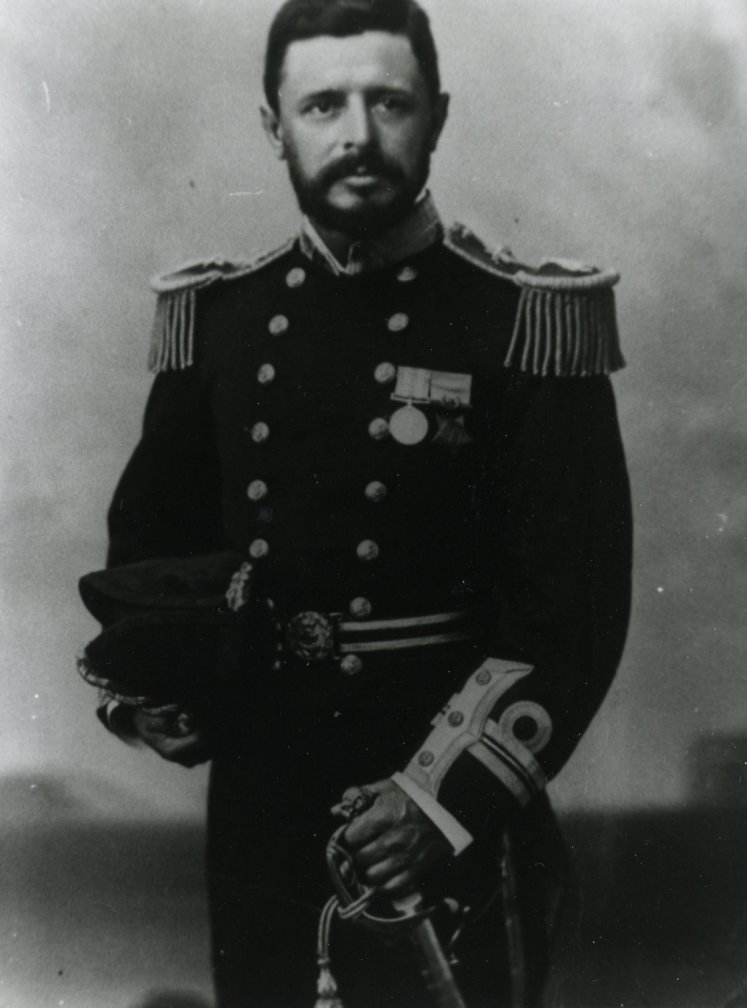
Commander Frederick Roope, R.N.
Taken circa 1895.
[Page 1]
Frederick Roope was born in Oporto on 31st August 1853, the second son of Cabel and Elizabeth Frederick Maria Roope. The Roopes had been in the Port Wine trade for generations, and Cabel (1823-1880) was a partner in Hunt Roope Teage & Co. of Oporto and London. Their eldest son Cabel (1852-1912), the last of the line to follow the family business, was an eccentric bachelor of convivial habits and considerable business acumen who became a legend in Oporto in his lifetime and beyond. (see "Port" by R. Croft-Cooke).
Maria was the daughter of Frederick Whitaker J.P. of Bampton Manor, Oxon. She married in 1851, and they had twelve children four girls and eight boys, though only the two eldest of the boys survived infancy or adolescence. Bampton Manor is today substantially unchanged, and is owned by the Munster family, the descendants of the Duke of Clarence (later William IV) by the actress, Mrs. Jordan. By an odd co-incidence Mary Roope (1773-1836), of the Norfolk branch of the family, was governess to the Fitzclarence children in the 1820s.
Maria Roope retired to Guildford after her husband's death in Oporto, and she died there in February 1902 aged 74. Her memorial carries the same inscription as this - "Thou knowest not what a day will bring forth."
Frederick was destined for the Navy. There was no naval or military tradition in the family. Since the early 1600s and beyond they had been merchants and minor gentry in south Devon and Oporto; if one excepts Nicholas, who was a prominent supporter of William of Orange at his landing at Brixham in 1688, and was made Governor of Dartmouth Castle for his services. Thereafter the Roopes minded there own business, and no public distinction or notoriety came their way.
Cabel, senior, divided his time between Oporto and London. The firm's City Office was opened in 1850 and he was responsible for sales of wine in England. Maria, with one or more of the children, also made frequent visits and her passport dated 1866 survives.
Frederick was sent to Mr. Eastman's Academy at Southsea to prepare for his entrance exam to the training ship "Britannia" at Dartmouth. He was required to report to the C. in C. Portsmouth on Wednesday 3rd April 1867 for medical and written examinations in English, French (with aid of dictionary), History, Geography, Arithmetic and the First book of Euclid. He duly passed, and was admitted to "Britannia" on 2nd May for a year's course. He was 13 years and 8 months old. A photograph in cadets uniform shows a
[Page 2]
self-confident lad, with cap rakishly askew. A note from one of his sisters many years later comments that this is her favourite photograph of him and that "he never grew an inch after he was 14."
There is no record of his life on Britannia, but he passed with a 2nd class certificate on 28th July 1868. His conduct was "very good and very exemplary", and he satisfied the examiners in "basic education, rigging and seamanship, use of the sextant, navigation and construction of charts." One must agree that "he had paid much attention to his studies." The training and discipline were harsh, and it required exceptional character to overcome the limitations of the course. Indeed, in the 1914-18 war the Navy suffered from lack of initiative by senior officers, suppressed by the system. (See Roskill - "Earl Beatty" 1980).
On 1st September 1868 he went to sea as Naval Cadet in preparation for his midshipman's examination.
The Navy he had entered was in the early stages of a revolution in motive power, armour and gunnery that was to transform the wooden, square rigged, broadside line of battleships of the 1850s, to the steel, 15" gunned, 20-25 knot fighting machines of the 1914-18 War.
The British fleet at the blockade of Sebastopol in 1855 was basically that of Nelson at Trafalgar; though the Admiralty had at last decided that such vulnerable and unmanoeverable vessels should have either steam power driving a propellor, or a paddle tug to get them into position, and on occasion out of trouble. (Paddle propulsion was quite impracticable for warships, and was abandoned by 1850). The engines however shook the wooden hulls so that they leaked, and the French invention of the shell projectile containing an explosive charge, made them fire traps. The last wooden line of battleship "Victoria" and "Howe" were completed as late as 1859/60, and there were then no iron ships sailing with the battlefleet, if one excepts floating batteries for coastal defence.
The conservatism of the Admiralty was not entirely hidebound. It was in Britain's interest as a world-wide colonial power with unchallenged naval supremacy, that the principles of warship construction should not change, until change was forced upon them; and in particular that with limited bunker capacity, a full sailing rig must be provided to give unlimited range.
The answer was the "Iron clad" built of iron, with an additional armoured belt on the waterline, and engines that could propel the ship at sea independently of sail. The prototype was "Warrior" 1860, with a speed under power of 14 knots, yet fully rigged on her three masts. Steel
[Page 2 verso]
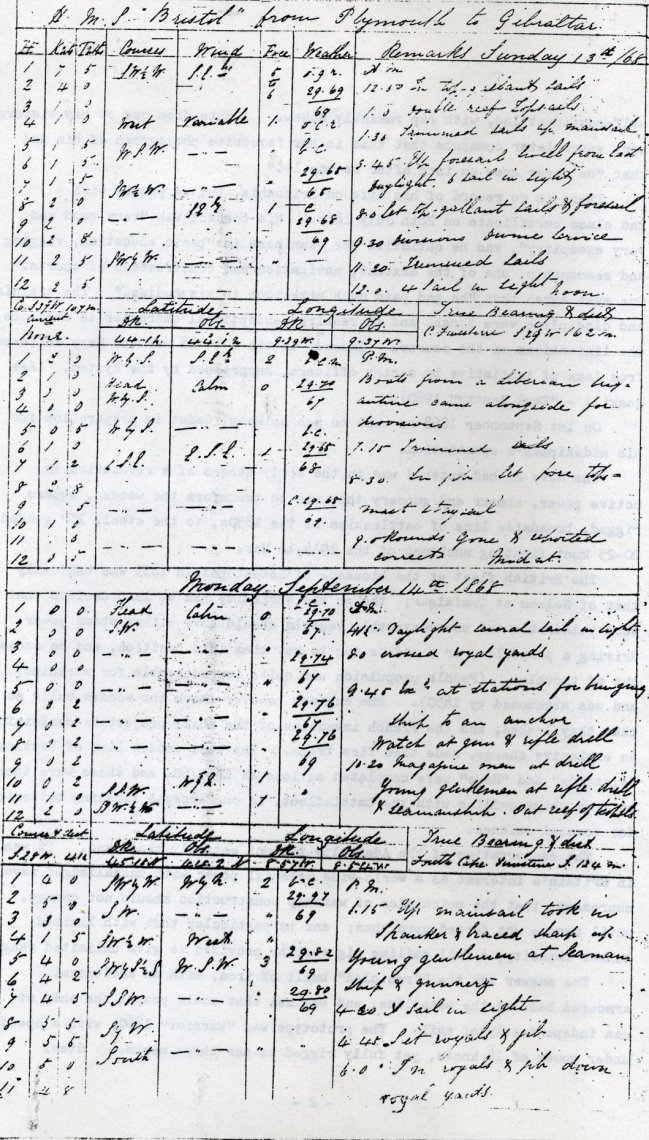
Log of H.M.S. "Bristol" 13 / 14 September 1868.
[Page 3]
superseded iron by 1880, and apart from sloops of "composite" construction (iron frames and wood planking to use up surplus timber) no more wooden vessels were laid down after the early '60s.
The smooth bore muzzle-loading gun of the '50s and '60s was also familiar to Nelson, though later types were rifled to fire the shell and were denoted by the diameter of the projectile. Armstrong's Breech Loading gun of 1855, with several times the rate of fire, was not adopted as the standard weapon for some 25 years, due to early types being prone to fatal explosion.
To fire a broadside, the ship had to be manoeuvred. The obvious development was to turn the guns and not the ship, by mounting them in turrets. The problem was that the heavy turrets must be above deck, altering the centre of gravity, and also lowering the freeboard. The dangers when a full rig was carried in heavy weather were shown when the "Captain" capsized in September 1870, with the loss of 482 men, and the Admiralty at last accepted that turrets and sail would not mix. The first battleship without a rig was "Devastation" of 1873, though smaller vessels retained their sailing rig to the 1890s, and were armed with a mixed collection of guns below deck and fore and aft. The drill of "up funnel, down screw" remained commonplace in the Service, the funnel being telescopic, and the screw lowered from inside the hull.
By 1877 a torpedo tube had been fitted to "Torpedo Boat No. 1" a vessel with the unprecedented speed of 19 knots. This was due to the advocacy of Captain Fisher, head of the Gunnery School, and future First Sea Lord. His prophecy that "the next war will depend on the use made of the Torpedo" came close to fulfilment in two World Wars.
Technical advances required higher training standards for seamen. The intolerable conditions above and below deck in a "Three decker" at sea, with discipline enforced by ruthless flogging, were eased*. A standard uniform was introduced in 1857, with the familiar bands of white tape on the collar. Pay was improved, with fixed periods of service, and opportunities given for advancement in specialist trades.
For officers, the problem was promotion. The last senior officers from previous wars were compulsorily retired in the early '60s, and some of them remembered Napoleon. Cadets were selected, not as previously, nominated by a patronage system. Promotion for the officer without influence or exceptional ability became possible. His peacetime advancement would largely depend on success in the training courses in one or more of the new specialist
-
* But the "cat" was not abolished, though regulated under the Naval Discipline Act 1866. "Friday 4th June 1869, 7-30 a.m. Punished Wm Phillips o/seaman, with 36 lashes, as per warrant". (Log H.M.S. "Defence", kept by Midshipman Roope, aged 15 years & 9 months)
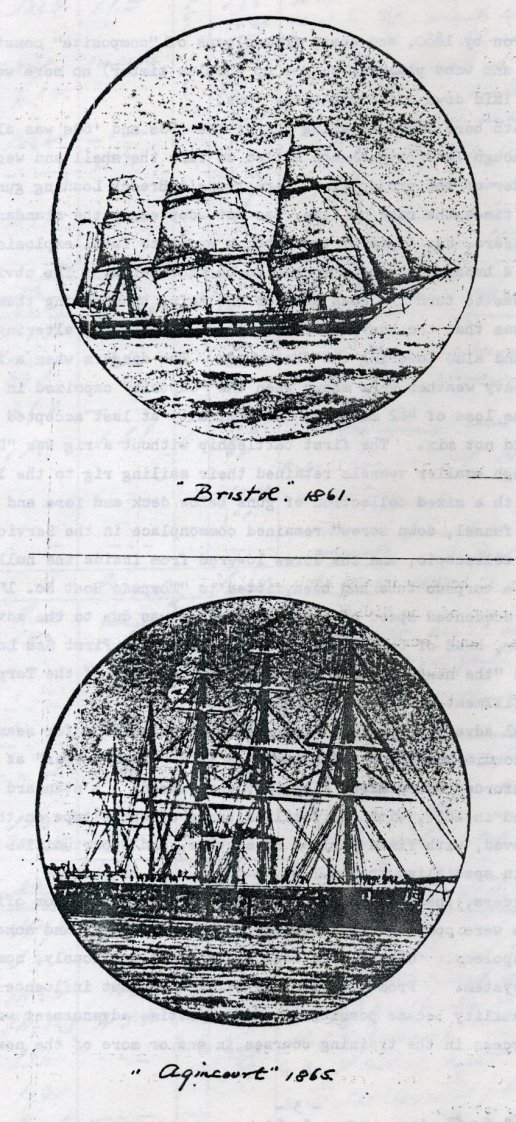
Image of "Bristol" 1861; Image of "Agincourt" 1865.
[Page 4]
branches, such as gunnery, navigation, signals and engineering.
Against this background Cadet Frederick Roope was posted to H.M.S. "Bristol" on 1st September 1868. She was a fully rigged wooden screw frigate built in 1861; 250 feet long and 4000 tons displacement, and armed with 1 x 112 pounder, and an assortment of smaller guns. There is a model of her in the Science Museum made by Commander Oliver who served in her in 1871. The description states that she was converted for midshipman training in 1870. Either the date is wrong or she was so used before conversion. In any case, Cadet Roope was among the earliest "intakes."
He had to keep a Log Book (see page 2 verso) - a daily record of latitude, longitude, wind and weather, and hourly events on the ship, from September 1868 to January 1869 She cruised to Gibraltar, Malta, Naples, Messina and Algiers. A typical entry reads :
                      "12.30 p.m. Lit fires in 2 after boilers;
                        2 p.m.    In topgallants, shortened and furled sails; down screw;
                        2.15      arrived Malta under steam, moored in Grand Harbour."
Sketches of headlands and harbours had to be included, and the Log was inspected as part of the Midshipman's Course.
In January and February 1869 he sailed with H.M.S. "Northumberland", a sister ship to "Agincourt."
Launched in 1865, these ships were then the most powerful in the Navy. Built of iron, they were 10,600 tons displacement, 400 feet long, fully rigged on all five masts, and carried a broadside of 28 x 9" muzzle loaders. The log records a cruise with the Channel Squadron to Lisbon; one entry again is typical.
               "23 Jan.  1.15      a.m. set mainsail; steaming as requisite to keep station;
                         5.15      out reefs of topsails
                         9.15      executed firing at target
                         2.10 p.m. made all plain sail.
                         3.45      mustered by Divisions with clean hammocks
                         4.25      Down-Royal Yards; took in 1 reef of topsails."
He was given a 1st class certificate and rated Midshipman on 28th January 1869. He had conducted himself "with sobriety and in accordance with printed instruction."
[Page 4 verso]
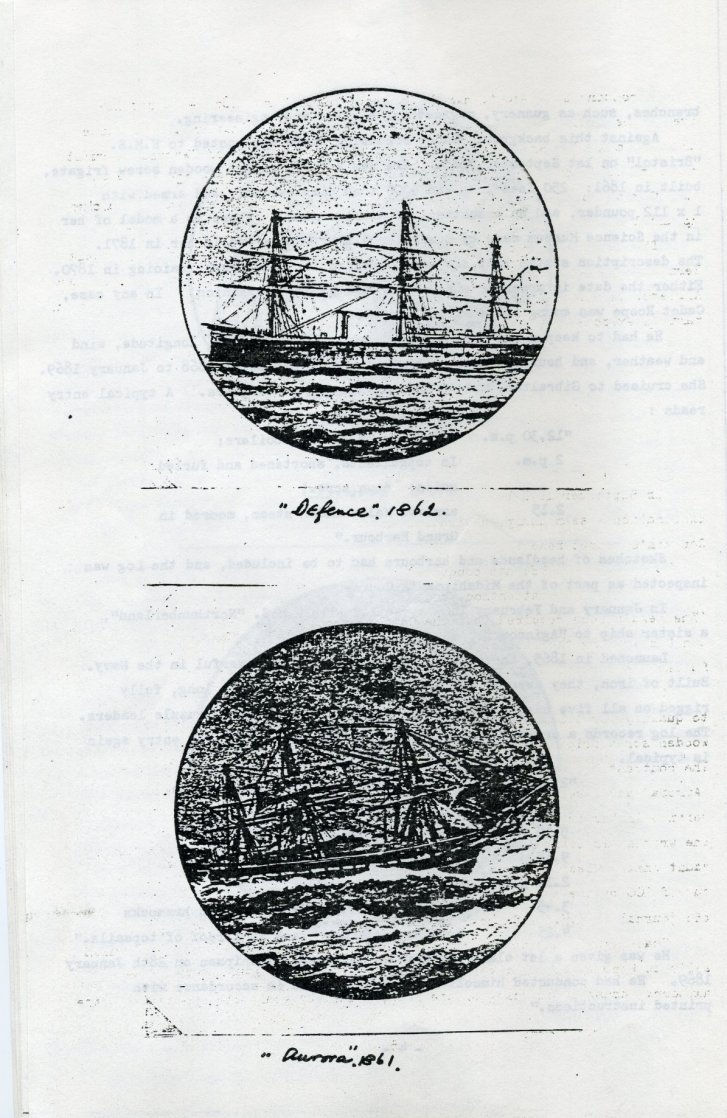
Image of H.M.S. "Defence" 1862; Image of H.M.S. "Aurora" 1861.
[Page 5]
A posting followed to H.M.S. "Defence" from March 1869 - August 1872 - over three years, to prepare for sub-Lieutenant's examinations. "Defence" dated from 1862. She was a smaller and improved version of "Warrior", built of iron, 6270 tons and 280 feet long, heavily armed with 6 x 110 pounders, and 10 x 68 pounders. She ended her life as a coal hulk and was not broken up until 1935.
The log was meticulously kept daily. "Defence" cruised to Nova Scotia, Bermuda, the Carribbean, Cuba, Lisbon, Gibraltar, Malta, the Meditteranean and Algiers, returning to Plymouth in July 1872. In September 1871 she had taken part in exercises with the Channel Squadron - for example:
                        "4Sept.    Making and shortening sail as requisite to keep station;
                         4.00 p.m. up screw, banked fires.
                         5.10      mustered at quarters; set Royals and studding sails; took station astern of Admiral."
In September 1871 he obtained a 1st class certificate in the intermediate examination - seamanship, navigation and gunnery being marked "good." His Captain's report read:
-
"He has conducted himself with sobriety, zeal and attention, and entirely to my satisfaction."
(The regulations required that the Captain-should "in all cases insert in his own handwriting the fact of the officer's sobriety, if he be worthy of it"). So far his career was promising.
Peace time cruising was routine; involving setting, furling and reefing sails to keep station; intermittent steaming in calm weather and entering harbour; constant cleaning of the ship, grimed by coal dust and smoke to the
[Page 5 verso]
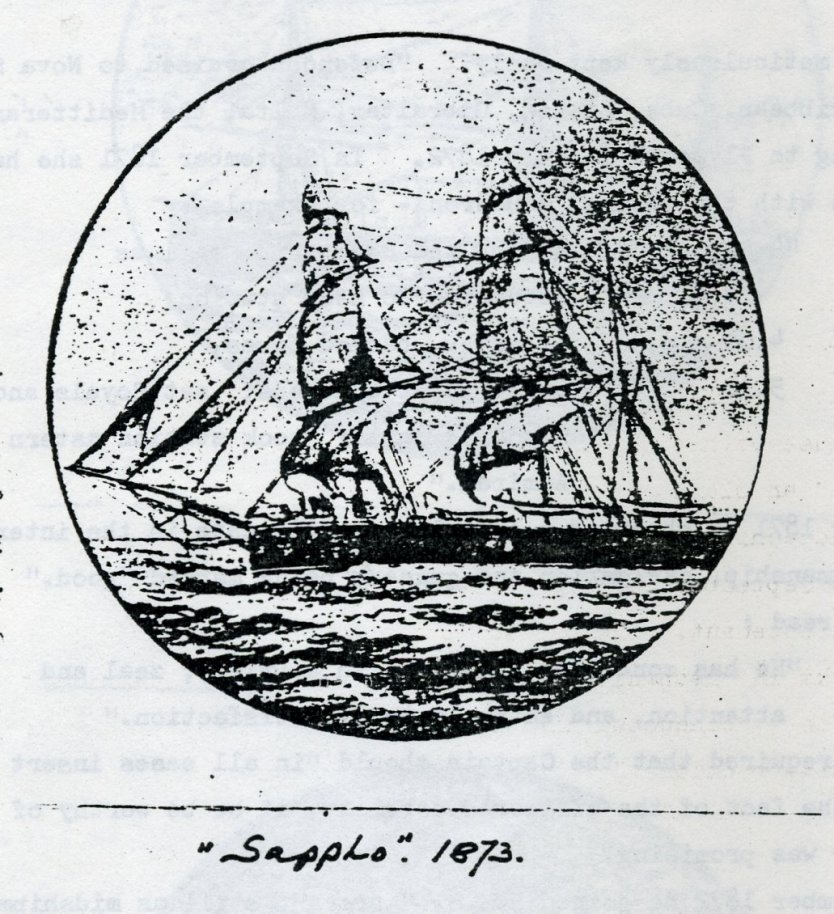
"Sappho" 1873.
[Page 6]
disgust of officers of the old school; Divine service on Sundays with-special provision for Roman Catholics; gun drill; sessions of making and mending clothes; occasional inspections by the Admiral; and the constant entry -
-
"Employed as requisite."
Perhaps because of his 3rd class in gunnery, he was sent on a course to H.M.S. "Excellent" an old three decker converted to a Gunnery School and training ship, and achieved a 1st class. After a month's leave, he returned to "Excellent" in September 1873 for a twelve months course to prepare for examination for Lieutenant. He passed, but with only 3rd class certificate and very poor marks in "mechanics and the steam engine." His report was hardly enthusiastic - "conducted himself with sobriety, and in accordance with the general instructions." Promotion to full Lieutenant followed on 28th December 1877, after 4½ years commissioned service, including 3½ years sea service on H.M.S. "Sappho." He was posted to her from 15th September 1874 to April 1878, his longest duty on any ship.
There is no record of "Sappho's" voyages. She was a sloop, built in 1873 of "composite" construction (wood and iron); 160 feet long and 940 tons displacement with 2 x 7" and 2 x 64 pounder guns. Her complement was 14 officers, 12 petty officers and 70-80 seamen. Life on board such a small ship must have been cramped in fine weather, and near intolerable in bad. Her Captain throughout was Commander Digby who reported on 13th April 1878:
-
"Mr. Roope has conducted himself with sobriety, and entirely to my satisfaction. During the 3½ years he has served with me, I have always found him to be zealous, trustworthy and in all respects a good officer."
[Page 6 verso]
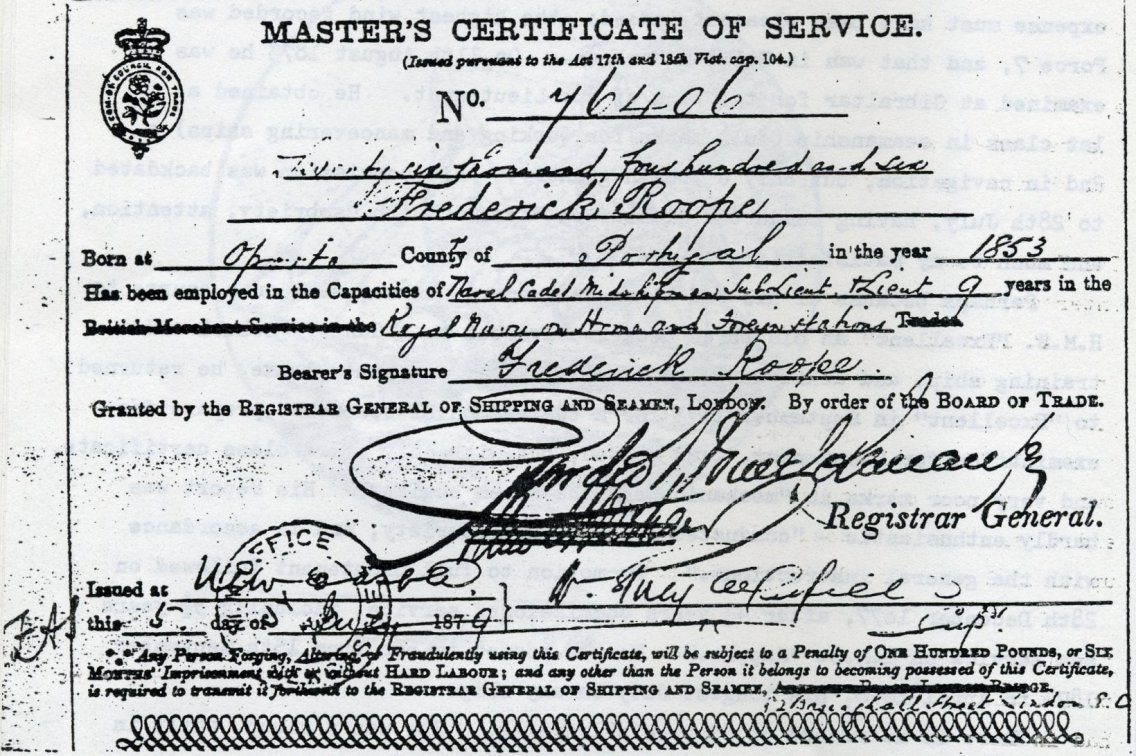
Master's Certificate of Service 5 July 1879.
[Page 7]
Lieutenant to a larger ship, or as navigating or executive officer to a small one. But after leave on full pay, he was placed on half pay from August '78 to October 1880. To a young officer of 25 this was frustrating and financial embarrasing. The Admiralty needed no further deterrent to keep their junior officers single. No marriage allowance was paid until 1938.
On 18th June 1879 he wrote to the Admiralty asking permission to take out a Master's Certificate in the Merchant Marine, as the only way to get to sea again. Consent was granted by return of post, and the certificate was dated 5th. July. He joined the "Zeta", a sailing ship with auxiliary engine, as 1st Officer for a four months' voyage from Newcastle to Tientsin. On his return in early 1880 he was sent on a Torpedo course to H.M.S. "Vernon", and obtained a report:
-
"Theory and practise very good."
At last the Admiralty sent him to sea again, as "additional" Lieutenant on "Repulse" for a summer cruise, May - July 1881. She was an iron-clad, similar in tonnage and design to "Defence". In August 1881, he was appointed to H.M.S. "Agincourt". (see page 4). She was by this date obsolete as a fighting ship, but her weight of broadside was well suited to bombard shore targets. (She ended her days as a coal hulk at Sheerness, where she remained until broken up in 1960 when the dockyard closed).
In July 1882, as part of the Channel Squadron, she proceeded to Alexandria, the sea port of Egypt. The British and French had important commercial and political interests in Egypt, notably the Canal, in which the British Government had in 1875 purchased the Khedive's shares. There are parallels between events in 1882 and 1956. In both cases a nationalist movement threatened British interests, and the Government intervened in conjunction with the French. In 1882 the pretext was the maltreatment of Europeans; in 1956 - the Nationalization of the Canal. The difference was that in 1882 no other Powers were in a position to interfere, and the sea and land operations restored the Khedive's authority within three months, and with it, British interests.
The British and French fleets accordingly bombarded Alexandria on 11th July in the hope that this would suffice; but British troops had to be landed before the revolt of Ahmed All was crushed at Tel-el-Kebir in September. Significant casualties of the Naval bombardment unfortunately included the remaining antiquities of the City. The grateful Khedive awarded a star, and the British Government a medal, to those taking part.
[Page 7 verso]
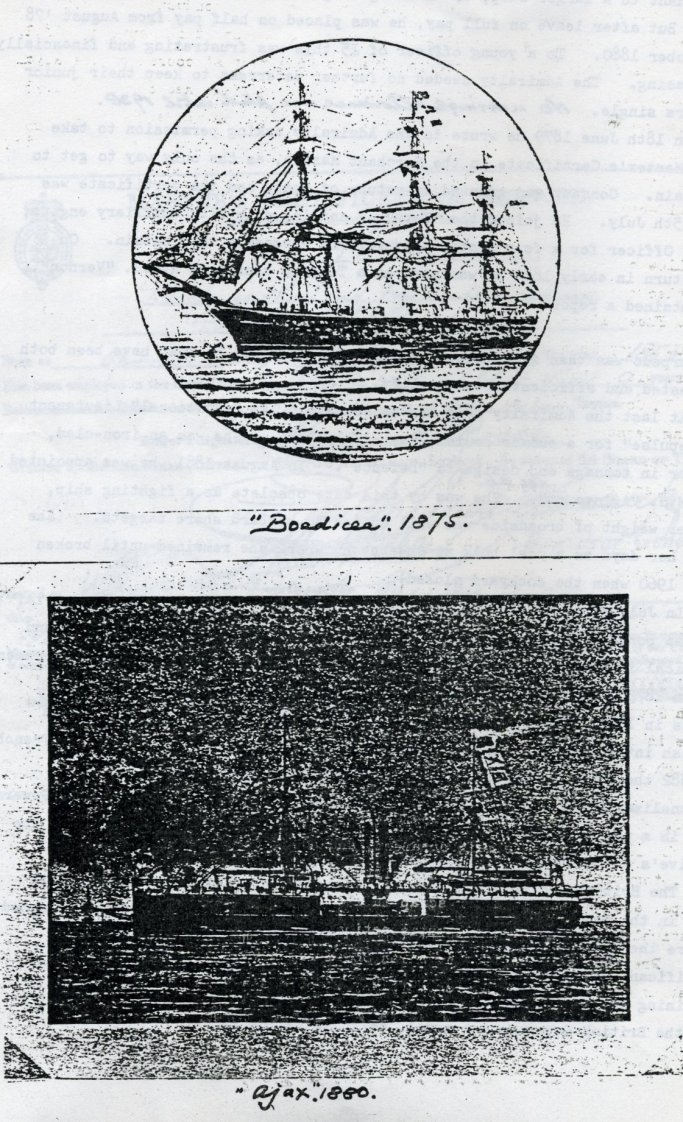
Image of "Boadicea" 1875; Image of "Ajax" 1880.
[Page 8]
Lieutenant Roope had seen active service and had conducted himself "to my satisfaction." "Agincourt" returned to Devonport in September 1882, and he was forthwith instructed to attend a nine months' course at the Royal Naval College, Greenwich, until June 1883. The College had opened in 1873 to give advanced training to selected officers with, in the early '80s, emphasis on new gunnery techniques. Success or failure would mark a turning point in an officer's career. He failed to qualify, and was again placed on half-pay. His report briefly stated:
-
"He has complied with the Regulations."
In October 1883 he was ordered to Cape Town to join H.M.S. "Boadicea", taking passage in the troopship "Euphrates." This appointment was to last eighteen months until July 1885. "Boadicea" was a "Corvette", the 1880's equivalent of a cruiser: She was built in 1875, 280 feet long, and some 4000 tons displacement, armed. with 14 x 7" and 2 x 64 pounder guns - a substantial and powerful ship for her time, and carrying a full rig on all three masts.
There is no record of her voyages in 1885, except that she was stationed in the Indian Ocean and Persian Gulf. He conducted himself as usual "with sobriety and entirely, to my satisfaction."
The next appointment, after full pay leave, was to H.M.S. "Ajax" from 11th September 1885, to 26th May 1886, stationed at Greenock. For the only time in his career, Lt. Roope served in a ship without a sailing rig - though as "Ajax" spent this period in harbour, the experience was academic. She was a "battleship" (the term replacing "ironclad") built of steel in 1880, of some 9000 tons displacement - the last heavy ship to be armed with muzzle loading guns as main armament, and among the first to be fitted with anti-torpedo nets. She and her sister "Agamemnon" proved unsatisfactory ships, and she was sold for scrap in 1905. He conducted himself on board "entirely" to the Captain's satisfaction.
Previous service in the Indian Ocean may have been a factor in his posting to H.M.S. "Osprey" on 27th May 1886, a sea-going appointment that
-
* Jellicoe had obtained three 1st Class Certificates in his Lieutenants exams and won an £80 prize at the R.N.C.
[Page 9]
was to last for three years until June 1889. She was a "composite" sloop built in 1876, similar in size and armament to "Sappho", and already outdated. He joined her at Aden in June.
The Arab slave trade still flourished on the East African coast from Zanzibar to the Persian Gulf. The Navy kept a squadron of sloops and gunboats based on Aden to catch, if they could, the slave running Dhows. The job was no sinecure, as the Dhows were fast, elusive and often showed fight. "Osprey's" journal kept by Lt. Roope as executive officer has survived, and gives a vivid account of one such operation:
-
"14th Sept. 1888: 8 p.m. Left Perim to cruise in Red Sea after slaves."
16th Sept. At daylight while steaming South off mocha sighted three Dhows ahead; increased speed; at 6.45 fired blank to stop them, the only notice taken being to alter course, and one Dhow setting her mizzen. It being evident they wished to avoid us, (we being so close the interpreter hailed and was answered) a shot was fired, so close to one of them that the spray splashed. over her. This had no effect so we cleared all guns, and tried to hit their masts away. As they seemed to despise the fire of heavy guns, small arms from the tops were set to work. At 7 a.m. the first Dhow lowered her sail and at 7.5 the second. We lowered a boat with Mr. Budge in charge, who boarded the first Dhow, the second being only 400 yards from her. We now turned our attention to the third, firing with the bow gun at 1800 yards. She was going before the wind at a good pace. At 7.30 she lowered her sail, we boarded and took her in tow, and proceeded toward the other two. While we were chasing the third Dhow, the second hoisted her sail again, but Mr. Budge with great promptitude opened fire with his rifles, and a few well directed shots brought him to his senses again. We then found these Dhows were full of slaves. We got the owners, Captains and crews on board; made them prisoners and then got the slaves on board; in
[Page 10]
-
first Dhow 78, second 64, third 62 - total 204. The Captains of the first and third Dhows were killed; as well as four slaves killed and four wounded. The slaves were about equally divided by sexes, and were Abyssinians, Dinkalis and Galis - a great number Christians. They were in good condition, especially the girls, and ages ranged from 8 to 18; a few of the boys were eunuchs. They were in a great fright when first brought on board. They had been shipped at Roheita - bound for Jiddah. The total tonnage of the three Dhows was only 42 as measured at Aden, so over 240 human beings were packed into these three boats for at least three days at sea. When we had all on board and Dhows secured, proceeded for Aden, arriving 6 p.m. on 17th. We landed 33 owners, Captains and crews, and handed them over to Aden Police.
18 Sept: 8 a.m. Landed 204 slaves; turned over the three Dhows to Prize Court, which were condemned and destroyed."
   "8 May:   8 a.m.    Left Gibraltar for Plymouth.
    9 -      8 p.m.    Rounded Cape St. Vincent. Winds S.E. - N.E. - dirty weather to Ushant.
    14th     8 p.m.    Rounded Ushant.
    15th     1.15 p.m. Sighted Eddystone. Made fast in Plymouth Sound to No.2 Buoy. Found there H.M.S. "Agincourt"
                       flying flag of Rear Admiral D'arcy Irvine, getting out coal preparatory to turning over to
                       "Anson". Discharged 23 supers,  invalids, prisoners and time expired men.
    16th     9 a.m.    Slipped and proceeded to Sheerness
    17th               Thick fogs, 4 p.m. anchored in Downs.
    18th     8 a.m.    Weighed and proceeded under Pilot for Sheerness, ariving 2 p.m. Out powder and shell; shifted
                       to No.19 buoy."
[Page 10 verso - Image of H.M.S. "Liberty" - not attached on copy.]
[Page 11]
- A year later "Osprey" was sold for scrap.
These three years were uncomfortable and responsible. The only recreation was occasional shooting expeditions after partridge and snipe, and no home leave. Lt. Roope obtained an excellent report:
-
"He has conducted himself with sobriety as Executive Officer during the whole period, and has done his work to my entire satisfaction."
After two months in port on the battleship "Hero" and a short Torpedo course on "Vernon" at Portsmouth, he was appointed on 9th January 1890 to his only Command - the training brig "Liberty". She was a small two-masted square rigged wooden vessel built in 1850 101 feet long and was "tender ship" to H.M.S. "Lion", a converted two-decker of 1847. Both ships trained boys for the Navy, and Liberty's job was to train them in sail. The appointment lasted three years, and the work was evidently congenial; - his report states:
-
"He took a great interest in the training of the boys."
Shore appointments followed from July 1893 - April 1895, at Devonport and Portsmouth, for service in the Naval Barracks and general duties Dockyard reserve - borne officially on the strength of H.M.S. "Victory."
The last four years until retirement were to be spent as Lieutenant and Divisional Officer, Whitstable Division Coast Guard, at Herne Bay from 1st May 1895 - 31st August 1898. Such appointments were normally given to Officers nearing retirement, who had seen active service. The Coast Guard was then a Coast Defence system, involving regular patrols, as well as control of smuggling and duties of warning and aid to vessels and their crews. From 1925 the service was transferred to the Board of Trade and Customs and Excise, with much reduced number's, and ceased to be a Naval responsibility.
[Page 11 verso]
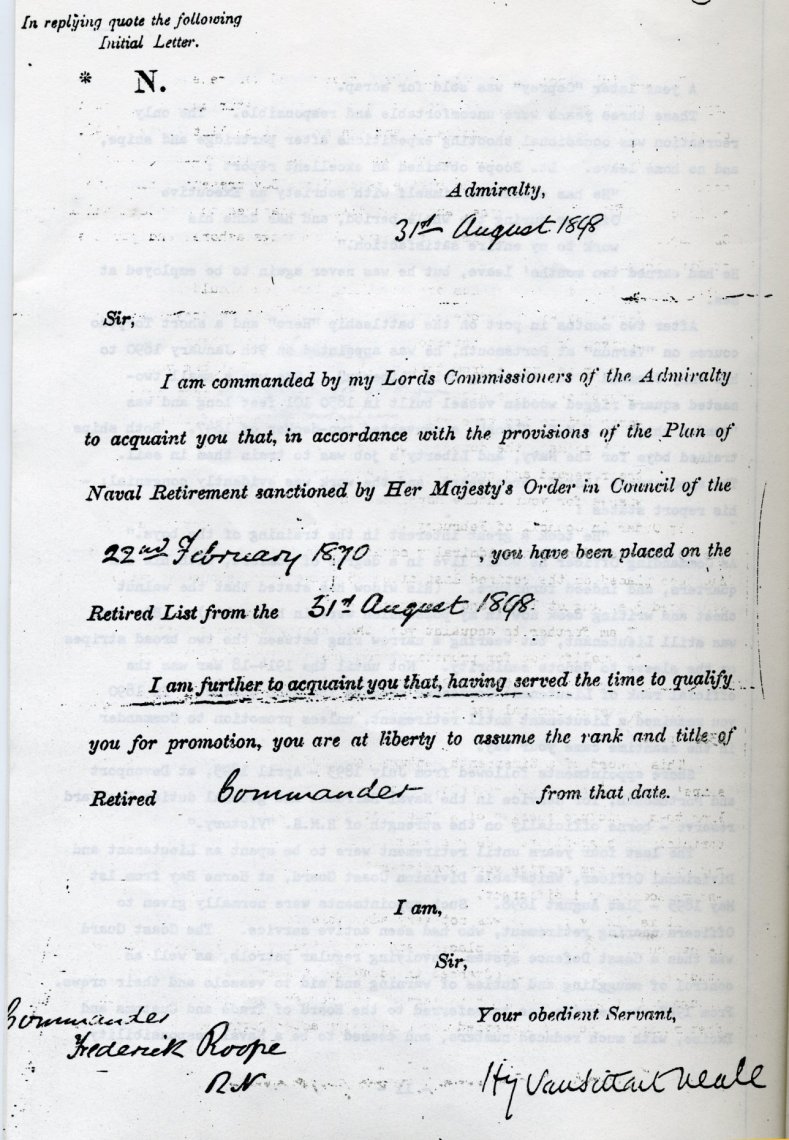
Retirement Letter to Commander Roope.
[Page 12]
The initial appointment was for three years, and was renewed in May 1898, "during pleasure, and subject to compulsory retirement on account of age." This was in fact imminent, and the axe fell on 31st August 1898.
The duties were relatively light, and there was considerable social activity. On his departure, 26 residents of Herne Bay presented him with an inscribed silver cigar case, and added their signatures to a "testimonial." One hopes the formal wording implies convivial evenings ashore, and parties at Divisional Headquarters:-
-
"A few of your friends are unwilling that you should leave Herne Bay without some expression of the pleasure they have derived from their intercourse with you, and of their regret at your departure from this neighbourhood. They beg your acceptance of the accompanying gift - not for its intrinsic worth (since its true value is to be found in the feelings which animate the donors), but as a feeble souvenir of their regard and goodwill, and an earnest of their heartiest wishes for your future happiness and prosperity."
-
"I am further to acquaint you, that having served the time to qualify you for promotion, you are at liberty to assume the rank and title of Retired Commander from that date."
This record of a Nineteenth Century Naval Officer's career is based on ships' logs, posting and reports, so carefully preserved by his widow. From them a picture emerges of a competent and conscientious officer, but certainly no high-flyer. He was essentially a practical seaman. His reports after sea service were consistently good; those after courses ashore sometimes indifferent.
It is likely that he was not very adaptable in a changing Service. He had no influence in high places, and the Admiralty evidently did not consider him sufficiently advanced in ideas or attainments for promotion, though had it come he would have served with competence and possibly distinction. He was unmarried for nine years after retirement, so one can
-
*Equivalent to around £7500 of 1981 money
[Page 13]
assume he was basically a self-sufficient man, who none-the-less enjoyed company, and had a sense of humour. He had various bachelor addresses in the Strand, Westminster, Kensington and Reigate, and visited, when on leave and after retirement, his brother Cabel, and his married sisters in Oporto. A photograph of 1903 shows him perched sideways on-a donkey in the hills near Busaco with a footnote -
-
"Crossing the Alps in an open boat."
He had bachelor quarters in Burnham and would visit them frequently where he met Anna Julia Ewens (Nancy). She was handsome and intelligent, and had left her home in Cullompton, Devon, to become a partner at Brean Down House, a girls school a few-minutes walk from the Morgans. He was to marry Nancy on the 16th April 1907 at Burnham-on-Sea.
It was a marriage of contrasts. She was tall - he was short. She had strict - even narrow - religious views; he had only the conventional middle-class background of the Church of England. He liked country pursuits - she had no interest. Perhaps her practical abilities to make and run the home he had lacked; her maturity (she was 32 in 1907) and even her religious convictions, appealed to a peripatetic bachelor of 53. It is unlikely he read his Bible daily - Nancy soon changed that. However this may be, their marriage of only four years was successful, based on mutual respect and affection.
He had bought a small house, Upper Warren, at Brean, a village four miles North of Burnham and Berrow. By 1907 he had added a wing and acquired some 48 acres of sand dunes across-the road at a price of thirty shillings an acre (which the locals considered exorbitant). Here rabbits abounded, and today the dunes carry a more profitable crop of holiday caravans. It was a life of Edwardian tranquillity - shooting, golf at Berrow, regattas at Burnham and excursions and hospitality with relatives and friends.
In 1910 the symptoms of a fatal cancer appeared. Seventy years ago the chances of successful treatment were remote; but radio-therapy was being
-
*In 1902 he married Florence Cayzer, daughter of a ship owner.
developed in Paris - and to Paris they went, staying at the Hotel Lord Byron in October and November 1910.
Their son, Frederick Cabel Roope, was born on 27th April 1911. A week later his father died at Upper Warren, Brean, and was buried in Berrow Churchyard, among the sand dunes and within the sound of the sea.
[Page 14 verso]
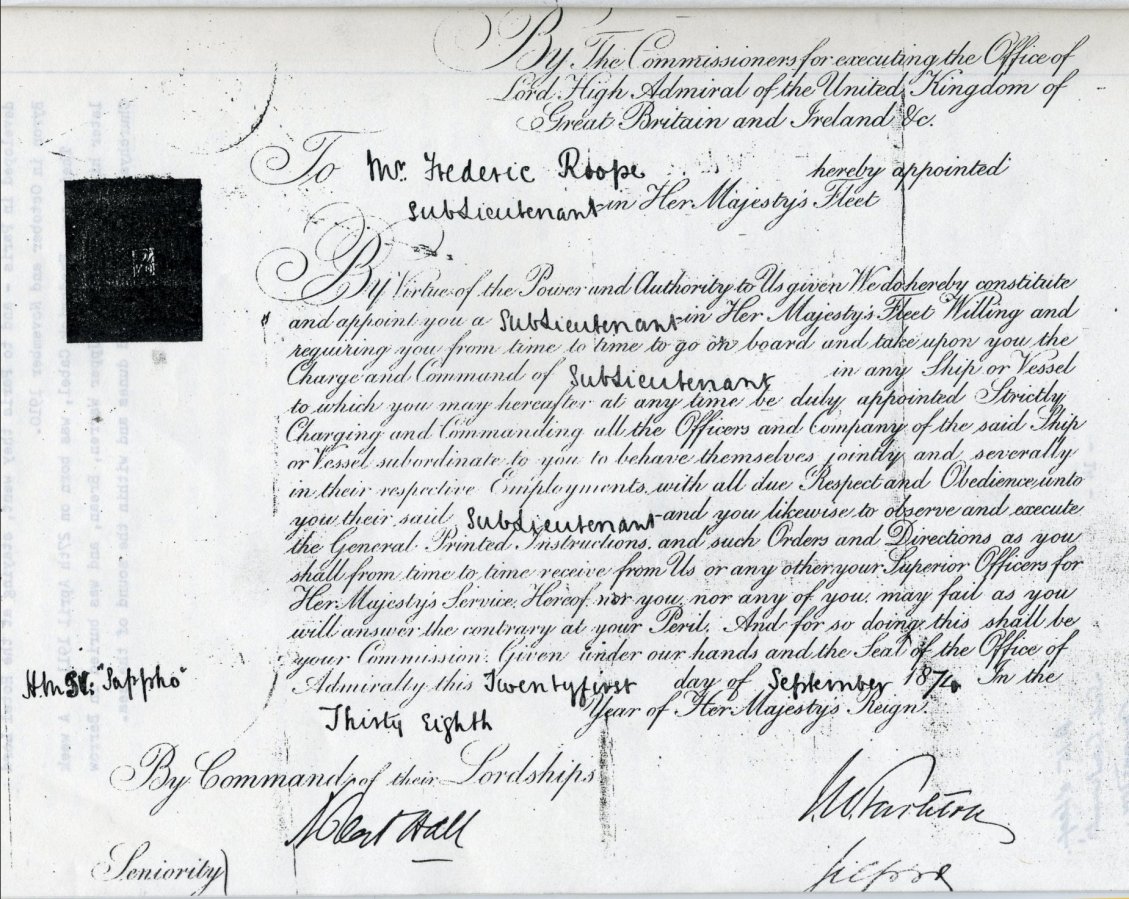
Sub-Lieutenant's Roope's Commission dated 21st September 1874
E N D